
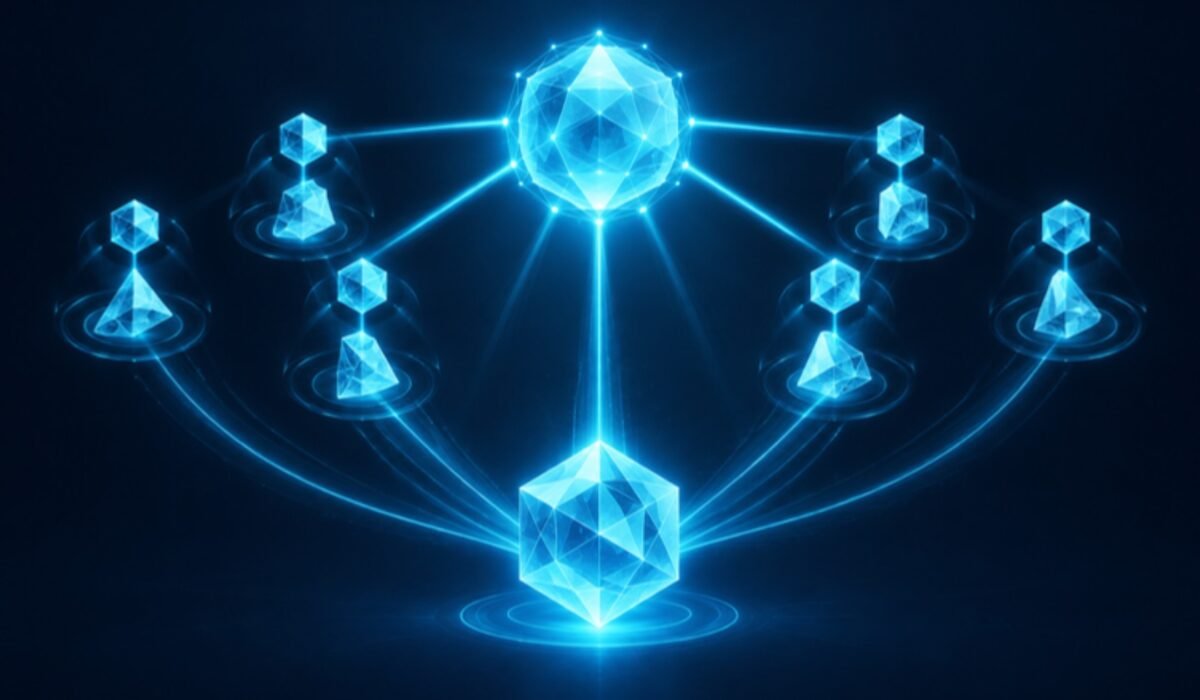
A single AI agent can research a topic, write code, or answer customer questions. But some jobs are too big, too broad, or too varied for one agent to handle well. A multi-agent system splits that work across several AI agents that cooperate, each focusing on part of the problem.
This guide explains what a multi-agent system is, how it works, the main design patterns, real results from production systems, and when a single agent is the better choice.
What Is a Multi-Agent System?
A multi-agent system (MAS) is a setup in which multiple AI agents work together to complete tasks for a user or another system. IBM defines it as multiple AI agents “working collectively” on tasks. Each agent stays autonomous, but the agents cooperate and coordinate to reach a shared goal.
Think of it as the difference between one generalist and a small team of specialists. One agent might search the web, another might analyze data, and a third might check the final answer.
New to agents? Start with AI Agents Explained and What Is Agentic AI.
How a Multi-Agent System Works
Most multi-agent systems share four basic parts:
- Agents: each agent has a role, instructions, and access to certain tools.
- Coordination: a lead agent or a set of rules decides who does what and in what order.
- Communication: agents pass tasks, results, and context to one another.
- Shared output: the results are combined into a final answer or action.
Communication can be handled inside one framework, or across vendors using an open standard such as the A2A (Agent2Agent) protocol. Each agent may also connect to its own tools and data using the Model Context Protocol.
5 Common Multi-Agent System Patterns
There is no single way to build a multi-agent system. These five patterns cover most designs you will see in practice.
1. Orchestrator-Worker (Supervisor)
A lead agent receives the request, breaks it into subtasks, and assigns them to worker agents. Workers report back, and the lead agent combines the results. This is the most common pattern because it keeps one clear point of control.
2. Sequential Pipeline
Agents work one after another, like an assembly line. For example, a research agent gathers sources, a writing agent drafts a report, and an editing agent polishes it. This pattern is predictable and easy to debug, and it is closely related to the agentic workflows many teams already use.
3. Decentralized Network (Peer-to-Peer)
Agents communicate directly with each other without a central controller. IBM notes that decentralized networks are more robust and modular, while centralized designs depend on one coordinator that can become a single point of failure.
4. Hierarchical
Agents are arranged in layers. A top-level agent manages several team leads, and each lead manages its own workers. This helps very large tasks stay organized, but every extra layer adds cost and delay.
5. Generator and Critic
One agent produces work, and another reviews it and suggests fixes. The loop repeats until the result passes. This pattern is useful for code, writing, and fact-checking, where a second opinion catches mistakes.
Real-World Example: Anthropic’s Research System
One of the most detailed public accounts comes from Anthropic. In June 2025, its engineering team described the multi-agent research system behind Claude’s Research feature.
- Design: an orchestrator-worker pattern. A lead agent plans the research and creates subagents that search in parallel, then a separate step attributes citations.
- Results: a lead Claude Opus 4 agent working with Claude Sonnet 4 subagents outperformed a single Claude Opus 4 agent by 90.2% on Anthropic’s internal research evaluation.
- Cost: Anthropic reported that agents typically use about 4 times more tokens than chat interactions, and multi-agent systems use about 15 times more.
- Best fit: tasks with heavy parallel work, information that exceeds a single context window, and many complex tools.
Anthropic also shared lessons from building it. Early versions created far too many subagents for simple questions, so the team added rules for scaling effort to the task. Subagents needed clear objectives, output formats, and boundaries to avoid duplicating work.
The Counterargument: When Multiple Agents Hurt
Not everyone agrees that more agents are better. In June 2025, Cognition, the company behind the Devin coding agent, published a post titled “Don’t Build Multi-Agents.” Its argument is that multi-agent setups can be fragile when agents do not share full context.
Cognition’s example: two subagents were asked to build parts of a simple game. One created a background in one visual style, and the other created a character in a different style, so the final pieces did not fit together. The post’s core principles are to share full context between agents and to recognize that conflicting decisions lead to bad results. For many tasks, it recommends a single-threaded agent instead.
The two views are not as opposed as they look. Anthropic’s research tasks are broad and easy to split into independent parts. Coding tasks often depend on many shared decisions. As Anthropic itself noted, most coding work has fewer truly parallel tasks than research.
Single Agent vs Multi-Agent System
| Factor | Single Agent | Multi-Agent System |
|---|---|---|
| Best for | Tightly connected tasks with shared decisions | Broad tasks that split into independent parts |
| Cost | Lower token use | Much higher token use |
| Speed on large tasks | Slower, works step by step | Faster when work runs in parallel |
| Consistency | High, one context | Risk of conflicting decisions |
| Debugging | Simpler | Harder, more moving parts |
Benefits of a Multi-Agent System
- Parallel work: several agents can explore different directions at the same time.
- Specialization: each agent can have focused instructions and tools.
- Larger scope: the system can handle more information than fits in one agent’s context window.
- Scalability: new agents can be added for new skills without rebuilding everything.
Challenges and Risks
- Coordination: agents can duplicate work, miss handoffs, or make conflicting choices.
- Cost: token use rises quickly as agents multiply.
- Compounding errors: one agent’s mistake can spread through the rest of the system.
- Debugging: runs are not fully repeatable, which makes problems harder to trace.
- Security: content passed between agents can carry manipulated instructions. Our guide to prompt injection explains the risk.
When Should You Use a Multi-Agent System?
A multi-agent system is worth considering when:
- The task naturally splits into independent parts, such as researching many companies at once.
- The information involved is larger than one agent can hold.
- The value of a better answer justifies higher compute costs.
Stick with a single agent when the task depends on many shared decisions, when cost matters more than speed, or when you are still proving that the task can be automated at all. Many teams start with one agent and add more only when they hit clear limits.
Conclusion
A multi-agent system lets several AI agents divide and conquer complex work. Done well, as in Anthropic’s research system, it can dramatically improve results on broad, parallel tasks. Done poorly, it adds cost, confusion, and conflicting decisions. The right choice depends on the shape of the task, not on how many agents you can run.
Frequently Asked Questions
What is a multi-agent system in simple terms?
It is a group of AI agents that work together on a task, with each agent handling part of the job and sharing results with the others.
What is an example of a multi-agent system?
Anthropic’s research system uses a lead agent that plans the work and several subagents that search in parallel, with results combined into one cited answer.
Are multi-agent systems better than single agents?
Not always. They tend to perform better on broad tasks that can be split up, but they cost more and can struggle with tasks that require tightly shared decisions.
How do agents in a multi-agent system communicate?
Agents pass messages, tasks, and results to each other, either within one framework or through open standards such as the A2A protocol.
What is the orchestrator-worker pattern?
It is a design where a lead agent breaks a request into subtasks, assigns them to worker agents, and combines their results.

The Future AI Wire Editorial Team covers artificial intelligence, AI agents, agentic AI, and emerging technologies. We publish clear, research-informed explanations and practical insights to help readers understand AI developments, real-world applications, and the technologies shaping the future.