
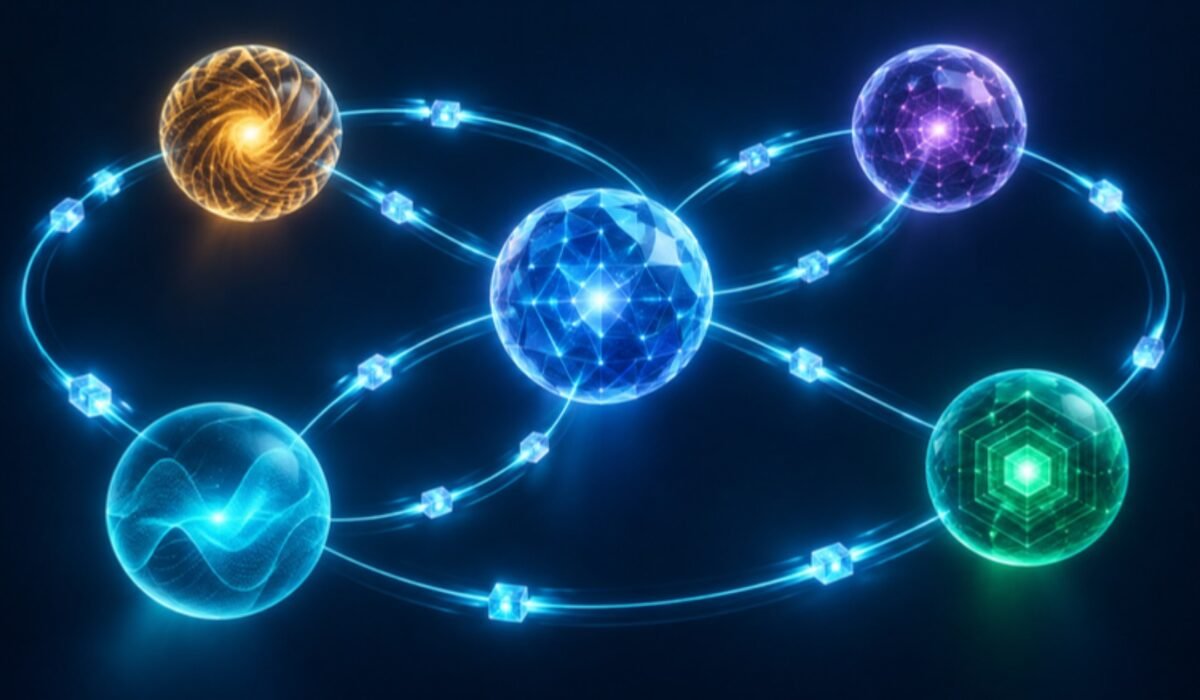
AI agents are getting better at handling tasks on their own. But most of them still work alone, inside one company’s software. The A2A protocol, short for Agent2Agent, is an open standard designed to change that by giving agents built by different vendors a common way to discover each other, share work, and return results.
This guide explains what the A2A protocol is, who created it, how it works, how it differs from MCP, and what to consider before using it.
What Is the A2A Protocol?
The Agent2Agent (A2A) protocol is an open standard for communication between AI agents. It lets one agent, called the client agent, find another agent, called the remote agent, understand what it can do, send it a task, and receive the result.
The key idea is interoperability. A support agent built on one platform should be able to hand a billing question to a finance agent built on another platform, without either side needing to know how the other was built.
The official A2A documentation sums up its scope simply: MCP is for agent-to-tool communication, while A2A is for agent-to-agent communication.
Who Created A2A?
Google introduced the A2A protocol on April 9, 2025, describing it as an open protocol that complements Anthropic’s Model Context Protocol. According to Google’s launch announcement, more than 50 technology partners supported it at launch, including Atlassian, Box, LangChain, MongoDB, PayPal, Salesforce, SAP, ServiceNow, and Workday.
Google later donated the project to the Linux Foundation. The A2A docs say the project is maintained by a Technical Steering Committee with representatives from AWS, Cisco, Google, IBM Research, Microsoft, Salesforce, SAP, and ServiceNow, and it is licensed under Apache 2.0.
In August 2026, the A2A project announced that it had been accepted as a Growth Stage project at the Agentic AI Foundation (AAIF), the Linux Foundation-directed home that also hosts MCP. The project says it is backed by over 150 organizations.
Why Agents Need a Shared Protocol
Without a standard, connecting two agents usually means writing a custom integration. Each connection has its own message format, its own way of tracking progress, and its own security setup. That approach does not scale when a company runs dozens of agents from different vendors.
A2A addresses this with a few design choices:
- Opaque agents: a remote agent is treated as a black box. Its internal memory, reasoning, and tools stay hidden. Agents collaborate without exposing how they work.
- Standard web technology: A2A runs over HTTP(S), so it fits into existing infrastructure.
- Long-running work: tasks can take seconds or much longer, and the protocol supports progress updates along the way.
- Any content type: agents can exchange text, files, and structured data.
How the A2A Protocol Works: 6 Core Concepts
The A2A key concepts guide defines a small set of building blocks. Understanding these six makes the rest of the protocol easy to follow.
1. Agent Card
An Agent Card is a JSON document that describes an agent: its identity, capabilities, skills, endpoint, and authentication requirements. Client agents read the Agent Card to decide whether a remote agent can help. The docs show a well-known location such as /.well-known/agent-card.json as an example of where a card can be published.
2. Task
A task is a stateful unit of work with a unique ID and a defined lifecycle. A task moves through states such as submitted, working, input required, and completed. It can also end as failed, canceled, or rejected. The “input required” state matters: it lets a remote agent pause and ask for more information instead of guessing.
3. Message
A message is a single turn of communication between the client and the agent. Each message has a role, either user or agent, and a unique ID.
4. Part
Parts are the content containers inside messages and results. A part can hold text, a file, a link to a file, or structured JSON data. This is how A2A supports text, documents, images, and forms in one format.
5. Artifact
An artifact is the concrete output a remote agent produces, such as a report, a file, or a data set. Artifacts can be delivered in pieces as the work progresses.
6. Streaming and Push Notifications
A2A supports three ways to follow a task: simple request and response with polling, real-time streaming using Server-Sent Events (SSE), and push notifications, where the remote agent calls a webhook when there is an update. Push notifications are useful for long tasks that may run while the client is offline.
A Simple A2A Workflow Example
Imagine a travel-planning assistant that needs help from specialist agents:
- The travel assistant (client agent) reads the Agent Cards of a flight agent and a hotel agent to see what each can do.
- It sends the flight agent a task: find flights from New York to London for specific dates.
- The flight agent marks the task as working and streams progress updates.
- It needs a decision, so it moves the task to “input required” and asks whether the traveler prefers a direct flight.
- The client answers, the flight agent finishes, and it returns an artifact with the flight options.
- The travel assistant repeats the process with the hotel agent and combines the results for the user.
Neither specialist agent needed to reveal its internal tools or data sources. That is the type of multi-step coordination described in our guide to agentic workflows.
A2A Protocol vs MCP
A2A and the Model Context Protocol are often mentioned together, and the official docs describe them as complementary rather than competing. The A2A documentation frames it this way: MCP deepens what a single agent can do, while A2A connects agents to each other.
| Aspect | A2A | MCP |
|---|---|---|
| Main purpose | Agents collaborating with other agents | AI applications using tools, data, and prompts |
| Other side of the connection | An independent agent that reasons on its own | A server exposing defined capabilities |
| Discovery | Agent Card | Server lists its tools, resources, and prompts |
| Unit of work | Task with a lifecycle | Tool call or resource read |
| Visibility | Remote agent is opaque | Tools are described in detail for the model |
| Originally introduced by | Google (April 2025) | Anthropic |
In practice, many systems use both. Each agent might use MCP to connect to its own tools, such as a database or calendar, while A2A handles the hand-off between agents. For more on MCP, see What Is Model Context Protocol and our comparison of MCP vs API.
Technical Details at a Glance
- Transport: communication happens over HTTP(S). The specification defines bindings for JSON-RPC 2.0, gRPC, and HTTP+JSON/REST.
- Version: the A2A specification lists 1.0.0 as the latest released version.
- Authentication: agents declare their authentication requirements in the Agent Card. Credentials are passed in HTTP headers, separate from A2A messages, using standard web methods such as OAuth or OpenID Connect.
- Extensions: agents can declare custom extensions in their Agent Card.
- Ecosystem: the A2A project reports native support from Google Cloud, AWS Bedrock AgentCore Runtime, and Microsoft Azure AI Foundry, and from frameworks including LangGraph, CrewAI, Pydantic AI, AG2, and IBM BeeAI.
Where A2A Is Useful
- Enterprise automation: a hiring agent coordinating with scheduling, background-check, and HR agents from different vendors.
- Customer service: a front-line support agent passing a refund request to a billing agent.
- Research and reporting: one agent gathering data while another analyzes it and a third writes the summary.
- Commerce: shopping, payment, and logistics agents working together on a single order.
New to agents in general? Start with AI Agents Explained and What Is Agentic AI.
Security Considerations
Letting agents talk to each other expands what automated systems can do, which also raises the stakes when something goes wrong. Keep these points in mind:
- Verify who you are talking to: only connect to remote agents you trust, and use the authentication schemes declared in their Agent Cards.
- Limit access: give each agent the minimum permissions it needs. The specification says servers must reject requests with missing or invalid credentials.
- Treat incoming content as untrusted: messages and artifacts from another agent can contain manipulated instructions. Read our guide to prompt injection for why this matters.
- Secure push notifications: webhook endpoints should authenticate incoming updates.
- Keep humans in charge of high-impact actions: payments, account changes, and outgoing messages should still require approval.
Conclusion
The A2A protocol gives AI agents a shared language for working together across vendors and platforms. Agent Cards handle discovery, tasks track the work, and artifacts deliver the results, all over standard web technology. With version 1.0 released, a place in the Agentic AI Foundation, and support from major cloud providers and agent frameworks, A2A is becoming a core piece of the multi-agent stack alongside MCP.
Frequently Asked Questions
What does A2A stand for?
A2A stands for Agent2Agent. It is an open protocol for communication and collaboration between AI agents.
Who developed the A2A protocol?
Google introduced A2A in April 2025 and later donated it to the Linux Foundation. In 2026 it was accepted as a project at the Agentic AI Foundation.
Is A2A a replacement for MCP?
No. MCP connects an AI application to tools and data. A2A connects agents to other agents. The official documentation describes them as complementary.
What is an Agent Card?
An Agent Card is a JSON document that describes an agent’s identity, skills, endpoint, and authentication requirements, so other agents can discover it and decide whether to work with it.
Is the A2A protocol open source?
Yes. The project is open source under the Apache 2.0 license and is maintained by a Technical Steering Committee that includes several major technology companies.
The Future AI Wire Editorial Team covers artificial intelligence, AI agents, agentic AI, and emerging technologies. We publish clear, research-informed explanations and practical insights to help readers understand AI developments, real-world applications, and the technologies shaping the future.