
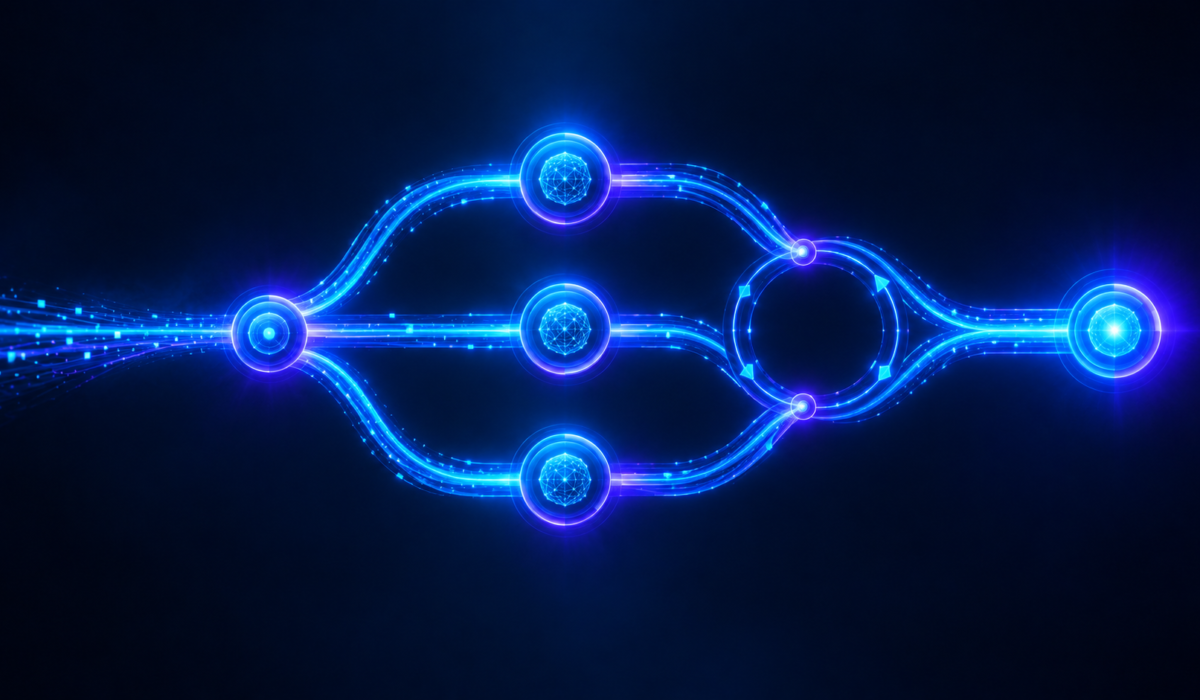
People use the phrase agentic workflows to describe many different things, from a simple chain of AI prompts to a fully autonomous agent. That makes it hard to know what is actually being discussed.
This guide clears up the terminology, explains the five most common patterns, and helps you decide when a structured workflow is a better choice than a fully autonomous agent.
What Is an Agentic Workflow?
An agentic workflow is a multi-step process in which an AI model reasons about a task, uses tools, and adapts as it goes, instead of producing a single response. It sits between a one-shot prompt on one side and a fully autonomous agent on the other.
Terminology varies, so it helps to follow one widely cited distinction. In its guide Building Effective Agents, Anthropic groups all of these designs as agentic systems, but separates two types:
- Workflows: systems where language models and tools are orchestrated through predefined code paths.
- Agents: systems where the model dynamically directs its own process and tool use.
In everyday usage, “agentic workflow” is applied to either one. This article covers both, and flags the difference where it matters.
Traditional Automation vs. AI Workflows vs. Agents
It is useful to think of a spectrum of control.
| Approach | Who decides the steps? | Typical example |
|---|---|---|
| Traditional automation | Fixed rules written in advance | If an invoice arrives, copy it to a folder |
| AI workflow | A predefined path, with the model handling individual steps | Summarize a document, then classify the summary |
| Agent | The model, step by step, within set limits | Research a topic, choose sources, and decide when it is done |
The more control the model has, the more flexible the system becomes, and the harder it is to predict. For a deeper look at how agentic systems work in general, see our guide to what agentic AI is.
Five Common Agentic Workflow Patterns
Anthropic describes five composable patterns. The examples below are illustrative.
1. Prompt Chaining
A task is split into a sequence of steps, and each model call works on the output of the previous one. Checks can be added between steps. For example, one step drafts an article outline, a check confirms it meets requirements, and the next step writes the full text.
2. Routing
An input is classified and sent to a specialized handler. For example, a support system can send billing questions, technical problems, and general inquiries to different prompts or tools, which keeps each one focused.
3. Parallelization
Multiple model calls run at the same time and their results are combined. Anthropic describes two forms: splitting a task into independent parts, and running the same task several times to compare answers for higher confidence.
4. Orchestrator-Workers
A central model breaks a task into subtasks as it goes, delegates them to worker models, and combines the results. This suits tasks where the needed steps cannot be known in advance, such as a coding change that touches several files.
5. Evaluator-Optimizer
One model generates a response and another evaluates it and gives feedback, repeating until the result is good enough. It works best when quality can be judged against clear criteria, such as refining a translation.
Where Agentic Workflows Are Used
- Customer support: routing requests, retrieving account data, and drafting replies for review.
- Software development: reviewing code, proposing changes, and running tests.
- Document processing: extracting fields, checking them against rules, and flagging exceptions.
- Research: searching sources, summarizing findings, and compiling a report.
Workflow or Full Agent?
Anthropic recommends finding the simplest solution possible and adding complexity only when it is needed. Workflows offer predictability and consistency for well-defined tasks. Agents are the better option when flexibility and model-driven decisions are required, but they typically cost more in time and money, and errors can compound across steps.
A practical approach is to start with a single model call, move to a fixed workflow if that is not enough, and consider an autonomous agent only when the path truly cannot be predefined.
Design Tips
- Define a clear goal and a clear stopping point for every workflow.
- Add human approval before actions that are hard to undo.
- Give each step only the tools and permissions it needs.
- Log each step so failures can be traced and fixed.
- Test on realistic examples before relying on the results.
Limitations
Agentic workflows can fail in ways that are hard to spot. Models make mistakes, and a mistake early in a chain can affect every later step. Costs and response times also rise as more model calls are added. Terminology and best practices are still evolving, so teams should check current guidance.
Conclusion
Agentic workflows range from tightly controlled chains of model calls to flexible agents that choose their own steps. The five patterns above cover many practical designs, and the best choice is usually the simplest one that reliably does the job.
At Future AI Wire, we will continue to explain the building blocks behind modern AI systems in clear, practical terms.
Frequently Asked Questions
What is an agentic workflow?
It is a multi-step process in which an AI model reasons, uses tools, and adapts across steps to complete a task, instead of producing one response.
What is the difference between a workflow and an agent?
In Anthropic’s framing, a workflow follows a predefined path, while an agent decides its own steps and tool use dynamically.
What are the main agentic workflow patterns?
Five common ones are prompt chaining, routing, parallelization, orchestrator-workers, and evaluator-optimizer.
Is an agentic workflow the same as automation?
No. Traditional automation follows fixed rules, while agentic workflows use a model to handle judgment, language, or changing conditions.
When should I use an agent instead of a workflow?
Use an agent only when the steps cannot be defined in advance and the benefits of flexibility outweigh higher cost and less predictability.
The Future AI Wire Editorial Team covers artificial intelligence, AI agents, agentic AI, and emerging technologies. We publish clear, research-informed explanations and practical insights to help readers understand AI developments, real-world applications, and the technologies shaping the future.