
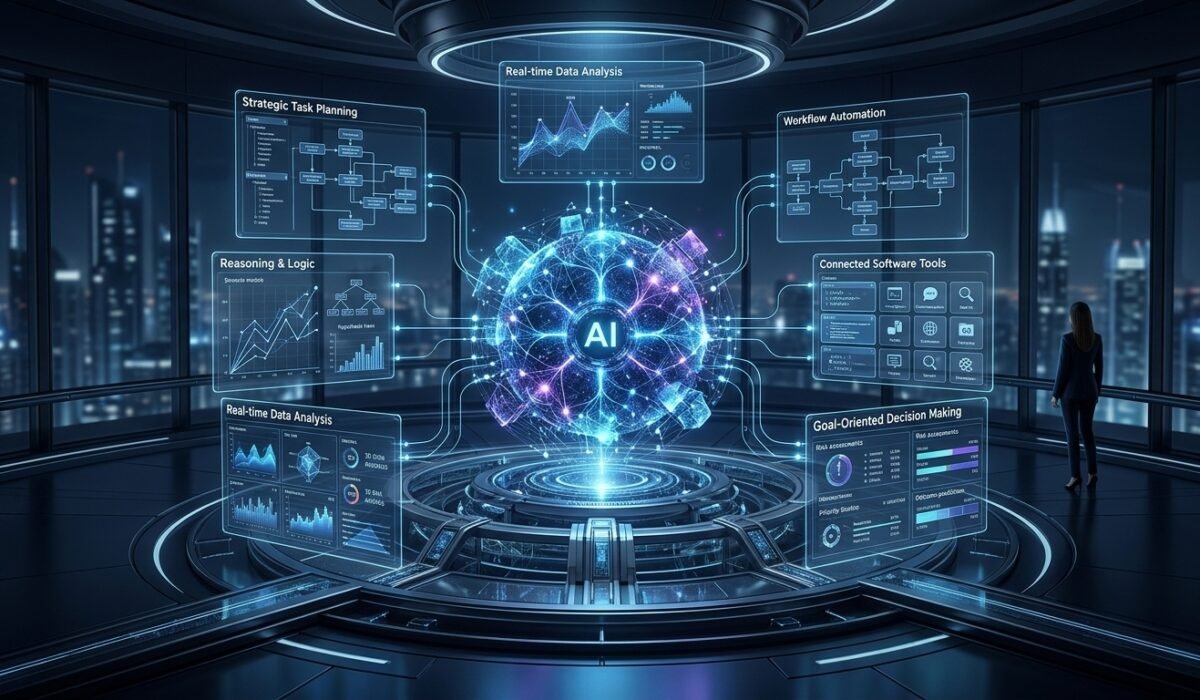
Artificial intelligence is no longer limited to answering questions or generating content. A growing category of AI applications can plan activities, interact with software tools, and take actions toward specific goals. This approach is known as agentic AI.
Instead of requiring instructions for every individual step, these systems can make decisions within defined boundaries and adjust their actions based on new information.
But what is agentic AI, how does it work, and what makes it different from traditional artificial intelligence?
This guide explains the technology in simple terms, explores practical examples, and examines its benefits, limitations, and potential future applications.
What Is Agentic AI?
Agentic AI refers to artificial intelligence systems designed to pursue goals by making decisions, using tools, and taking actions with varying levels of autonomy.
Unlike systems that primarily respond to individual prompts, agentic applications can coordinate several activities to achieve a broader objective.
For example, imagine asking an AI application to research competing products and prepare a comparison report.
A conventional chatbot might explain how to conduct the research or generate a response using the information already available to it.
An appropriately configured agentic system could search approved sources, collect relevant product information, compare findings, and prepare a structured report for human review.
The defining feature is goal-directed action. Rather than only suggesting what should happen next, the system can participate in carrying out the necessary steps.
However, autonomy does not mean unrestricted independence. Agentic systems operate according to their available tools, permissions, instructions, and safety controls.
How Does Agentic AI Work?
Agentic AI typically combines an AI model with planning mechanisms, external tools, and feedback processes.
Although implementations differ, many systems follow a recurring workflow.
1. Understanding the Goal
The process begins when a user or connected application provides an objective.
For example, a marketing manager might ask an AI system to analyze customer feedback and identify recurring complaints.
The application interprets the request and identifies the information required to complete it.
2. Planning the Actions
The system may divide the objective into smaller activities, such as collecting reviews, identifying common themes, organizing findings, and preparing a summary.
Some applications create detailed plans, while others determine their next actions dynamically.
3. Using Available Tools
Agentic applications can interact with connected services such as databases, search tools, document repositories, or business software.
These integrations allow the system to gather information and perform authorized actions.
4. Evaluating Results
After completing an action, the system examines the outcome.
If information is missing or a tool produces an error, the application may revise its approach or request clarification.
5. Completing the Objective
The process continues until the task is completed, a stopping condition is reached, or human intervention becomes necessary.
One influential research approach is the ReAct framework, which explores how language models can combine reasoning with actions and observations.
ReAct provides a useful example of goal-directed AI behavior, although not every agentic application uses this particular framework.
Agentic AI vs Traditional AI: What’s the Difference?
The main difference between agentic AI and many traditional AI applications concerns how they pursue objectives.
Traditional AI
Traditional AI systems are commonly designed around specific functions, such as recognizing images, predicting outcomes, recommending products, or generating content.
These systems can operate automatically, but their behavior is often organized around predefined tasks.
Agentic AI
Agentic systems emphasize selecting and coordinating actions to achieve a goal.
Rather than following only a fixed sequence, they may respond to intermediate results and adjust their next steps.
Consider a customer support application.
A conventional automated system might provide a predefined response when a customer selects a particular option.
An agentic application could examine the customer’s request, retrieve relevant account information through authorized tools, identify possible solutions, and prepare an appropriate response.
Importantly, traditional AI and agentic AI are not mutually exclusive. Agentic applications often incorporate conventional machine learning models and standard automation tools.
Difference Between ChatGPT and Agentic AI
ChatGPT and agentic AI are frequently compared, but they represent different concepts.
ChatGPT is an AI assistant product. Agentic AI describes a broader approach to designing systems that pursue goals through decisions and actions.
Depending on its available features and tools, ChatGPT can support research, coding, information analysis, and multi-step activities.
Therefore, describing ChatGPT as purely reactive would be inaccurate.
The more meaningful distinction concerns how an application is configured.
An agentic application is generally designed to manage a workflow, interact with connected systems, and determine appropriate next actions within defined boundaries.
Some conversational AI products also incorporate these capabilities.
As AI assistants develop, the distinction between chat-based interfaces and agentic functionality is becoming less rigid.
Agentic AI vs AI Agents
The terms agentic AI and AI agents are closely related, and they are sometimes used interchangeably.
However, there is a useful distinction.
Agentic AI describes the broader approach of building AI applications that can pursue objectives through decision-making and actions.
An AI agent is a particular software system or component that performs tasks within an environment.
For example, a business might deploy an AI agent to retrieve documents, analyze information, and prepare reports.
That application may use agentic techniques to decide which information to retrieve and how to complete the requested work.
For a deeper explanation of agent architecture, memory, planning, and different agent types, read our guide on how AI agents work.
Real-World Agentic AI Examples in 2026
Agentic capabilities are becoming increasingly relevant in software development, customer service, research, and business applications.
Software Development
Coding agents can assist developers by examining repositories, identifying potential bugs, suggesting changes, and running tests.
These tools can reduce repetitive development work, although generated code still requires appropriate review.
Customer Support
Agentic customer service systems can retrieve relevant information, classify requests, and coordinate routine support workflows.
Sensitive actions, including changes to customer accounts or financial records, should remain subject to appropriate verification and permissions.
Business Research
Research-oriented applications can gather information from available sources, organize findings, and prepare summaries.
For example, a market research system could compare publicly available product information and generate a draft competitor report.
IT Operations
Agentic applications can help IT teams investigate alerts, analyze system information, and recommend troubleshooting steps.
Automated changes to production environments require stronger safeguards because incorrect actions could interrupt services.
Benefits of Agentic AI
Agentic AI offers several potential advantages when applied to suitable workflows.
Reduced Repetitive Work
Agentic applications can coordinate routine activities that would otherwise require repeated manual interaction with different software tools.
Greater Workflow Flexibility
Some systems can change their approach when new information becomes available instead of following a completely fixed sequence.
Improved Information Processing
Agents can help collect, organize, and summarize information from multiple authorized sources.
Potential Productivity Gains
By assisting with repetitive research and administrative activities, agentic systems may allow employees to spend more time on work requiring human judgment.
However, productivity improvements are not automatic. Actual results depend on system reliability, task complexity, operating costs, and implementation quality.
Agentic AI Risks and Limitations
Despite its potential, agentic AI introduces challenges that businesses and developers need to address.
Incorrect Decisions
AI systems can misunderstand instructions, generate inaccurate information, or choose inappropriate actions.
In multi-step workflows, early mistakes may influence later decisions.
Security Vulnerabilities
Agentic applications that process external content may encounter malicious instructions, including prompt injection attempts.
Without appropriate safeguards, these attacks could influence tool usage or expose sensitive information.
Goal Misalignment
An agent may pursue a narrowly defined objective while overlooking important constraints.
For example, a system focused entirely on reducing customer support response times might prioritize speed over quality unless additional requirements are established.
Privacy Concerns
Applications connected to private documents, customer records, or personal information require strong access controls and responsible data management.
Operational Costs
Complex workflows may involve repeated model calls and external services, increasing operating expenses.
In some situations, simpler automation may be more reliable and cost-effective.
These limitations highlight the importance of testing, monitoring, restricted permissions, and human oversight.
Future of Agentic AI: 2026–2030
The future of agentic AI will depend on improvements in reliability, reasoning capabilities, tool integration, security, and operating costs.
2026–2027: More Reliable Applications
Developers are likely to continue improving workflow monitoring, execution controls, and evaluation methods.
Organizations may increasingly test agentic applications for clearly defined tasks where results can be measured.
2028–2029: Advanced Workflow Coordination
Improvements in software infrastructure could make it easier to coordinate specialized agents across complex workflows.
However, multi-agent systems will still need to demonstrate practical advantages over simpler approaches.
2030: Wider Integration
By 2030, agentic capabilities could become more deeply integrated into business software, productivity applications, and research tools.
Advances in robotics may also expand the use of goal-directed AI in physical environments.
These possibilities are not guaranteed predictions. Their development will depend on technical progress, economic conditions, regulations, and public trust.
Will Agentic AI Replace Human Jobs?
Agentic AI may automate portions of work involving repetitive information processing, administrative activities, and software-based workflows.
However, automating individual tasks does not necessarily mean eliminating entire occupations.
Many jobs involve interpersonal communication, accountability, complex judgment, and physical responsibilities that current agentic systems cannot reliably perform independently.
The broader employment impact will depend on how organizations adopt the technology and how job responsibilities evolve.
Skills related to AI supervision, workflow design, system evaluation, and responsible automation may become increasingly valuable.
Conclusion
Agentic AI represents an important shift in artificial intelligence because it combines information processing with goal-directed actions.
Rather than only generating responses, these systems can coordinate tools, evaluate outcomes, and participate in completing complex workflows.
Potential applications include software development, customer support, business research, and administrative automation.
However, reliability, security, privacy, and human oversight remain essential considerations.
At Future AI Wire, we continue exploring how emerging AI technologies may influence businesses, industries, and everyday life.
Frequently Asked Questions
What is agentic AI in simple terms?
Agentic AI refers to artificial intelligence systems that can work toward goals by making decisions, using tools, and taking actions within defined boundaries.
What is an example of agentic AI?
A coding agent that examines software, identifies a potential bug, suggests a correction, and runs tests is an example of agentic AI functionality.
Is agentic AI the same as generative AI?
No. Generative AI focuses on producing content such as text, images, or code. Agentic AI focuses on selecting and performing actions toward objectives. Agentic applications can use generative models as components.
Does agentic AI require human supervision?
The required level of supervision depends on the task. Sensitive or high-impact actions generally require stronger safeguards and appropriate human approval.
Can ChatGPT support agentic AI workflows?
Yes. Depending on available features and integrations, language models used in conversational assistants can support tool-based and multi-step workflows.
What are the biggest risks of agentic AI?
Important risks include inaccurate decisions, security vulnerabilities, privacy concerns, unauthorized actions, and errors that accumulate during multi-step workflows.
