
What Are AI Agents?
AI agents are autonomous intelligent systems that can understand complex goals, create plans, use external tools, make decisions, and execute multi-step tasks with minimal human intervention. They represent a major evolution in artificial intelligence — moving from reactive tools to proactive, goal-oriented collaborators.
AI Agent vs AI Chatbot: Key Differences
The difference is very important. While chatbots like ChatGPT are reactive and only respond when given a prompt, AI agents are proactive. They can break down large objectives, use multiple tools, maintain memory across sessions, and keep working until the goal is completed. This behavior is part of what many experts now call agentic AI.
Current State of AI Agents in 2026
As of 2026, AI agents have moved from academic research into early real-world use. Many organizations are testing and deploying them for automation of knowledge work, though most still use them with some level of human supervision.
How AI Agents Work
Most modern AI agents operate using a reasoning loop called the ReAct framework (Reasoning and Acting). The agent interprets the goal, makes a plan, uses tools, observes results, and continuously adjusts its strategy.
AI Agent Architecture Explained
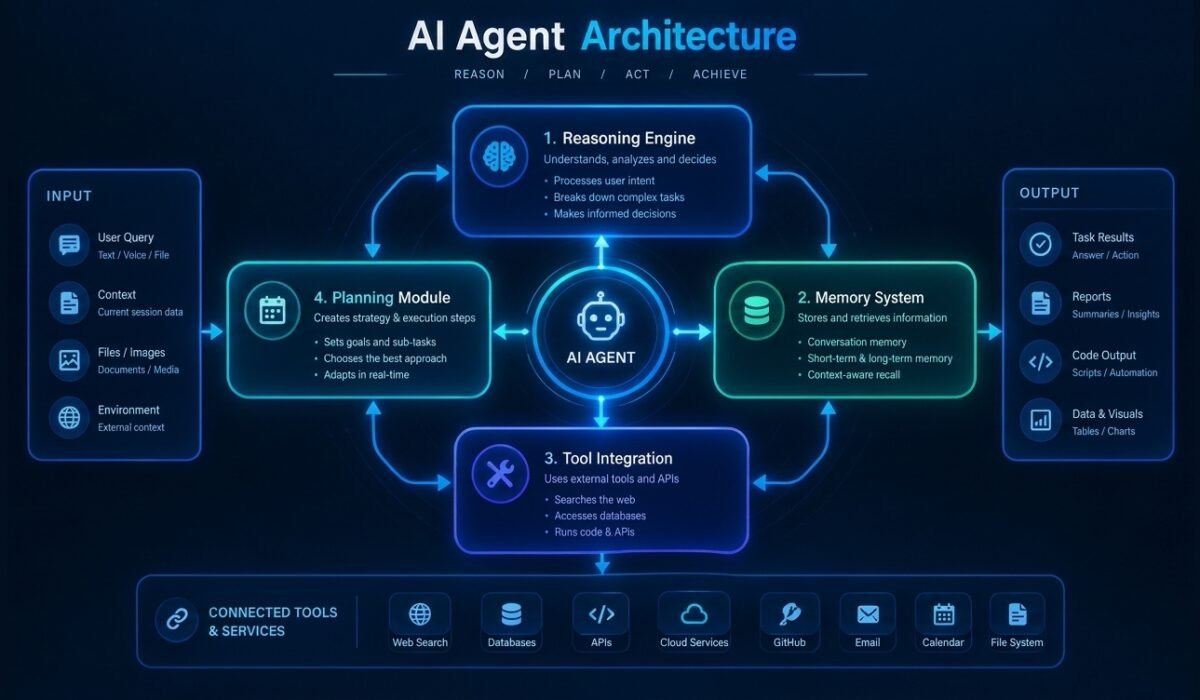
A typical AI agent architecture consists of four main components: a reasoning engine, a memory system, a tool integration layer, and a planning module. These layers work together to give the agent both intelligence and the ability to act autonomously.
Memory and Planning in AI Agents
Memory and planning are two of the most critical capabilities. The memory system allows agents to remember past actions and outcomes, while the planning module helps break down complex goals into smaller tasks and adapt when challenges arise.
Types of AI Agents
In 2026, the most discussed types include goal-oriented agents, utility-based agents, embodied AI agents, and multi-agent systems where several specialized agents work together as a team.
Real World AI Agent Examples in 2026
Companies are currently using AI agents for competitive research, large-scale content creation, sales lead qualification, software debugging, and automated reporting.
Key Use Cases Across Industries
AI agents are being applied across many sectors — from summarizing the latest medical research in healthcare to monitoring financial markets, automating customer support workflows, and creating personalized learning paths in education.
Open Source AI Agents
The open source community has accelerated progress significantly. Popular frameworks include LangGraph, CrewAI, and AutoGen. These tools allow developers to build custom agents while keeping full control over data and infrastructure.
Limitations and Challenges
Despite their capabilities, AI agents still have important limitations such as high computational costs, occasional hallucinations, difficulty with completely new situations, and the risk of agentic AI risks and limitations.
Future of AI Agents (2026–2030)
2026 and 2027 are seen as the early adoption phase. From 2028 to 2030, multi-agent systems and more advanced embodied agents are expected to become common. For a deeper understanding of the goal-driven approach behind these systems, read our detailed guide on What is Agentic AI.
Conclusion
AI agents represent one of the most important developments in artificial intelligence this decade. Understanding how they work, their architecture, real use cases, and limitations will be valuable knowledge as this technology continues to mature.
Frequently Asked Questions
What are AI agents in simple terms?
AI agents are intelligent systems that can independently plan and complete complex tasks to achieve a specific goal.
What is the difference between AI agents and ChatGPT?
ChatGPT responds to prompts, while AI agents can take a goal, make plans, use tools, and work autonomously until the task is done.
Are AI agents safe for business use in 2026?
They can be used for many tasks, but important decisions should still have human oversight due to risks of errors and goal misalignment.
