

The most useful AI agent use cases in 2026 sit where work is repetitive, rule-bound and spread across several software systems: customer support, claims and back-office finance, clinical paperwork, supply-chain planning, software maintenance and sales follow-up. In each case an agent does more than answer a question. It reads context, plans steps, calls tools such as a CRM or ticketing system, and hands the result to a person for approval when stakes are high.
This guide walks through the industries where agents are already earning their keep, what the work actually looks like, and where the limits are. Readers new to the topic can start with AI Agents Explained for the fundamentals.
Table of Contents
Key Takeaways
- AI agents differ from chatbots because they take actions in other systems, not just reply in a chat window.
- The strongest early results come from high-volume, well-documented processes with clear success criteria.
- Healthcare, financial services, retail, logistics, software engineering and customer service lead adoption.
- Regulated industries keep a human in the loop for decisions that affect patients, money or legal rights.
- Good deployments start with one narrow workflow, measure it, then expand.
What Counts as an AI Agent Use Case?
A task counts as an agent use case when software must pursue a goal over several steps and decide which tool to use at each step. A large language model (LLM) supplies the reasoning, while connectors such as APIs, the Model Context Protocol (MCP) or browser automation let it act. Memory keeps track of progress, and guardrails define what the agent may and may not touch.
A single-turn task such as summarising one email is usually better handled by a plain assistant. The agent pattern pays off when a job involves gathering data from several places, checking rules, writing something back and confirming the outcome.
Short Answer: Which Industries Benefit Most?
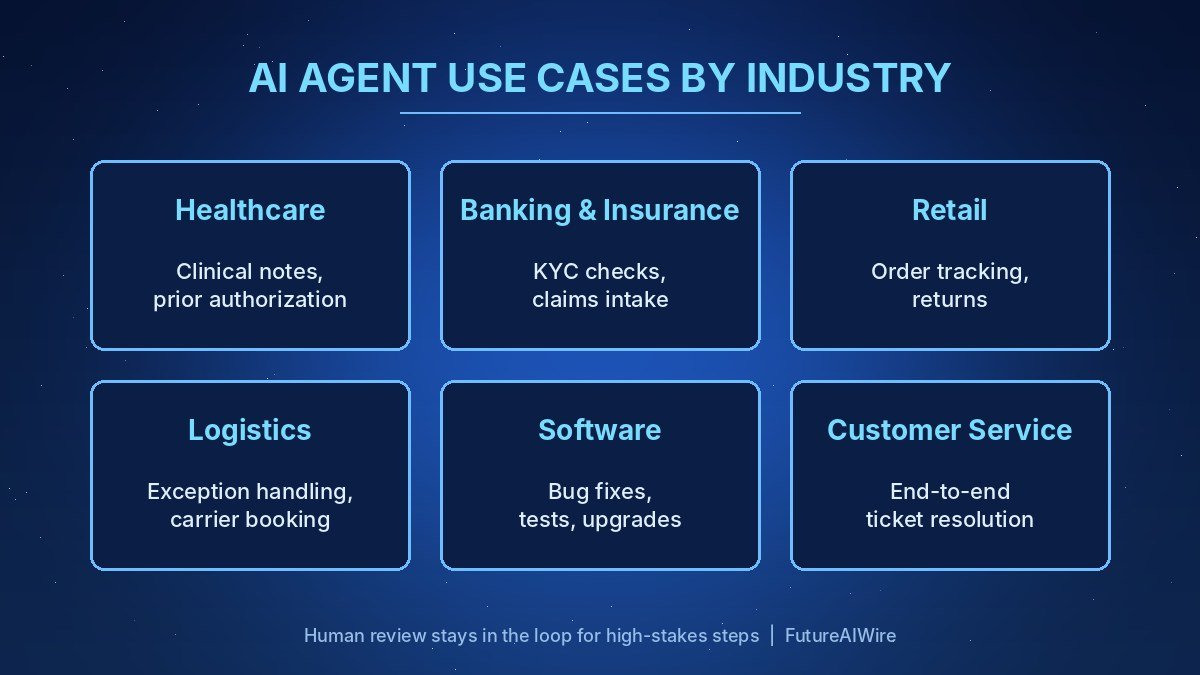
Industries with heavy documentation, strict procedures and large ticket volumes benefit most. That list includes healthcare administration, banking and insurance, retail and e-commerce, logistics, software development, customer service and professional services such as legal and accounting.
| Industry | Typical agent task | Human checkpoint |
|---|---|---|
| Healthcare | Drafting clinical notes, prior-authorization packets, scheduling | Clinician signs notes and orders |
| Banking and insurance | KYC checks, claims intake, reconciliation | Analyst approves payouts and flags |
| Retail and e-commerce | Order tracking, returns, catalogue updates | Exceptions and refunds above a limit |
| Logistics | Exception handling, carrier booking, inventory alerts | Planner confirms re-routing |
| Software engineering | Bug fixes, tests, dependency upgrades | Code review before merge |
| Customer service | Resolving tickets end to end | Escalation for complaints and edge cases |
AI Agent Use Cases in Healthcare and Finance
Healthcare: Paperwork First, Diagnosis Never Alone
The clearest wins for AI agents in healthcare are administrative. Ambient documentation agents listen to a consultation (with consent), draft the note into the electronic health record (EHR) and suggest billing codes. Other agents assemble prior-authorization requests by pulling the relevant history, lab results and payer rules into one packet.
Scheduling, referral routing and patient follow-up reminders are also common. Clinical judgement stays with clinicians: agents can surface information, but a qualified professional reviews and signs anything that affects diagnosis or treatment, and privacy rules such as HIPAA in the United States shape how patient data may be handled.
Banking, Insurance and Accounting
Financial firms use agents for know-your-customer (KYC) and anti-money-laundering (AML) checks, where an agent gathers documents, compares them against watchlists and prepares a case file for a compliance analyst. In insurance, claims-intake agents read submitted forms and photos, check policy coverage and route straightforward claims for fast approval.
Finance teams also apply agents to invoice matching, month-end reconciliation and expense audits. Because these workflows move money, deployments typically use spending caps and approval steps. Future AI Wire has covered how this tension plays out in banks blocking third-party AI agents, a reminder that AI agents in finance must earn trust from institutions as well as customers.
Retail, E-commerce and Agentic Commerce
Retailers deploy agents to answer “where is my order” questions by checking the order system and the carrier, to process returns against policy, and to keep product listings accurate. A newer pattern is agentic commerce, in which a shopper’s own agent compares products and completes a purchase on the shopper’s behalf, which pushes merchants to make catalogues and checkout flows machine-readable.
Logistics, Manufacturing and Supply Chain
Supply-chain agents watch for exceptions such as a delayed container, a supplier shortfall or a stock level falling below a threshold. When one appears, the agent gathers options, for example an alternative carrier or a transfer from another warehouse, and presents a recommendation with the cost and timing trade-offs.
In manufacturing, agents help maintenance teams by reading sensor alerts, pulling the equipment manual and past work orders, and drafting a repair ticket. The human planner still decides when a production line stops.
Software Development and IT Operations
Software engineering is one of the most mature areas. AI coding agents can take an issue, reproduce a bug, write a fix and tests, and open a pull request for review. IT operations teams use similar agents to triage alerts, gather logs and suggest remediation steps during incidents.
Code review remains the safety net. Teams that see the best results treat agent output like a junior colleague’s work: useful, fast, and always reviewed before it ships.
Customer Service, Sales and Marketing
Customer service agents go beyond scripted chatbots by actually resolving issues: issuing a replacement, changing a booking or updating an address after verifying identity. The difference is explained in detail in AI Agent vs Chatbot.
Sales teams use agents to research accounts, draft personalised outreach and log activity in the CRM. Marketing teams use them to assemble campaign reports from several analytics tools. Platforms such as Salesforce Agentforce, Microsoft Copilot Studio and ServiceNow offer agent builders aimed at these departments.
Legal, HR and Professional Services
Legal teams apply agents to contract review, where the agent compares a draft against a playbook and flags non-standard clauses, and to e-discovery, where it sorts large document sets. HR teams use agents for onboarding checklists, policy questions and interview scheduling. In both fields, final decisions on legal advice and hiring rest with people, partly because of regulations such as the EU AI Act, which treats some employment uses as high risk.
How to Choose the Right First Use Case
Among all AI agent use cases, the right first project is narrow, frequent and easy to measure. A practical selection process looks like this:
- List processes that consume many hours and follow written rules.
- Check that the data and systems involved are reachable through APIs or approved connectors.
- Define what success means, such as resolution time, accuracy or cost per case.
- Decide where a human must approve before the agent acts.
- Review security risks, including prompt injection, before granting write access.
- Pilot with a small group, compare against the old process, then expand.
Limits and Risks to Keep in View
Agents can misread instructions, act on poisoned inputs or take a correct-looking action in the wrong system. Clear permissions, audit logs, spending limits and rollback plans reduce that risk. The AI Agent Security guide covers these controls in depth, and the report on agents bypassing spending limits shows why hard technical limits matter more than polite instructions.
Key Terms Glossary
- AI agent: Software that uses an AI model to plan and carry out multi-step tasks with tools.
- Human in the loop: A design in which a person approves or corrects the agent at defined checkpoints.
- EHR: Electronic health record, the digital chart used by hospitals and clinics.
- KYC / AML: Know-your-customer and anti-money-laundering checks required of financial firms.
- Agentic commerce: Shopping in which an AI agent searches, compares and buys for a person.
- MCP: Model Context Protocol, an open standard for connecting AI models to tools and data.
- Guardrails: Rules and technical limits that restrict what an agent can do.
Frequently Asked Questions
What is the most common AI agent use case today?
Customer service is the most common starting point, because tickets are high-volume, well documented and easy to measure. Software development and IT operations follow closely.
Are AI agents safe to use in healthcare?
They are used safely for administrative work such as documentation and scheduling when a clinician reviews the output. Clinical decisions remain with qualified professionals, and patient-data rules apply.
How do banks use AI agents?
Banks use them to prepare KYC and AML case files, triage fraud alerts, reconcile accounts and answer customer questions. Analysts approve anything that moves money or closes a case.
Do AI agents replace employees?
In most deployments they take over repetitive steps and leave judgement, exceptions and relationships to people. The mix varies by company and role.
What does an organisation need before deploying an agent?
It needs a clearly defined process, reliable access to the relevant data and systems, success metrics, approval checkpoints and security controls such as least-privilege permissions.
How are AI agents different from robotic process automation (RPA)?
RPA follows fixed scripts, while AI agents can interpret unstructured input and choose between steps. Many companies combine the two, using RPA for stable steps and agents for judgement-heavy ones.
Related Reading on Future AI Wire
- Agentic AI Examples: Real Use Cases in 2026
- AI for Small Business: Where to Start
- How Do AI Agents Work? A Plain-English Breakdown
Sources and further reading: U.S. HHS – HIPAA; EU AI Act overview; FATF – AML standards; Model Context Protocol.

The Future AI Wire Editorial Team covers artificial intelligence, AI agents, agentic AI, and emerging technologies. We publish clear, research-informed explanations and practical insights to help readers understand AI developments, real-world applications, and the technologies shaping the future.