

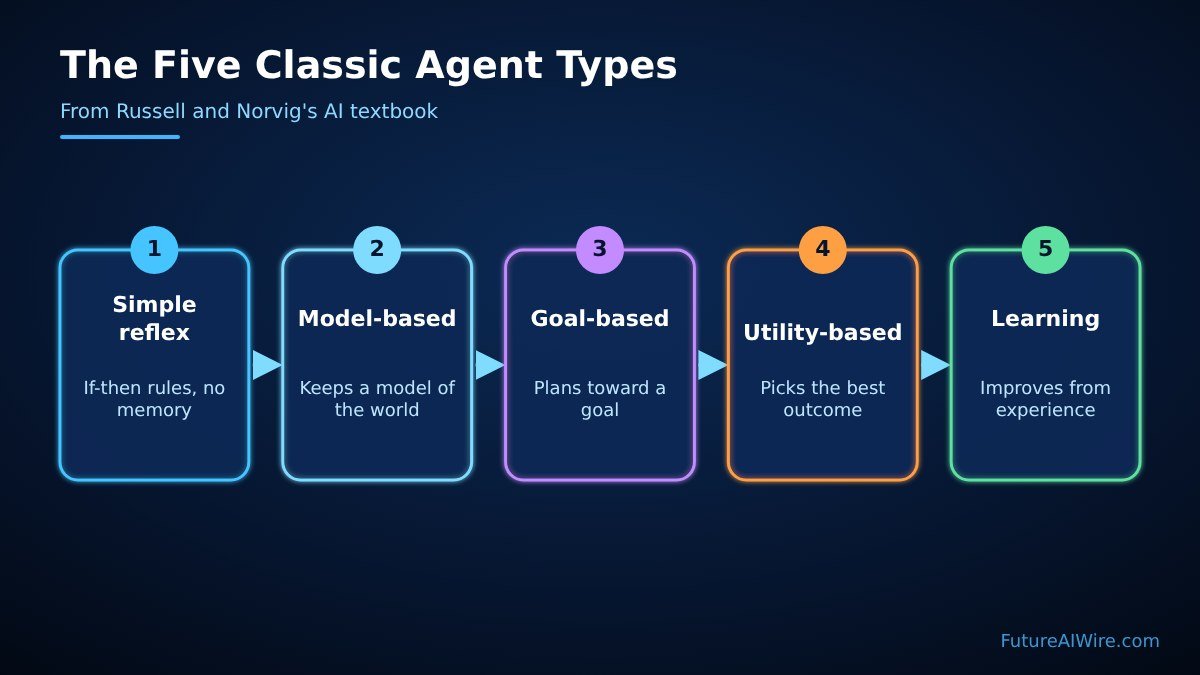
The main AI agent types are simple reflex agents, model-based reflex agents, goal-based agents, utility-based agents and learning agents. Modern systems add hierarchical agents, multi-agent systems and LLM-based agents. Each type of AI agent differs in how much it remembers, plans and learns.
Key Takeaways
- The five classic types come from AI textbooks and range from simple rules to learning systems.
- Goal-based and utility-based agents plan ahead; reflex agents only react.
- Most modern products are LLM-based agents that combine several classic types.
- Choosing the right type depends on task complexity, risk and how much the environment changes.
Table of Contents
The Short Answer
An AI agent perceives its environment, decides and acts. The classic classification, popularized by Russell and Norvig’s Artificial Intelligence: A Modern Approach, groups agents by how they make decisions. The pillar guide AI agents explained covers the basics behind all of them.
1. Simple Reflex Agents
Simple reflex agents act on the current input only, using if-then rules. They have no memory of the past.
- Example: a thermostat that turns on heating below a set temperature, or a spam filter with fixed rules.
- Strength: fast and predictable.
- Limit: fails when the right action depends on history.
2. Model-Based Reflex Agents
These agents keep an internal model of the world, so they can track things they cannot see right now.
- Example: a robot vacuum that maps rooms and remembers which areas are clean.
- Strength: handles partially observable environments.
- Limit: still reacts by rules rather than planning toward a goal.
3. Goal-Based Agents
Goal-based agents choose actions that move them toward a defined goal, often by searching and planning.
- Example: a navigation app that plans a route to a destination.
- Strength: flexible when conditions change.
- Limit: treats all paths to the goal as equally good.
4. Utility-Based Agents
Utility-based agents rank outcomes by how desirable they are, using a utility function. They pick the best option, not just any option that works.
- Example: a ride-hailing system that balances price, wait time and driver distance.
- Strength: handles trade-offs well.
- Limit: defining the right utility function is hard.
5. Learning Agents
Learning agents improve with experience. They have a learning element, a performance element, a critic that gives feedback and a problem generator that tries new actions.
- Example: a recommendation engine that adjusts to what users click, or a game-playing agent trained with reinforcement learning.
- Strength: gets better over time.
- Limit: needs data and can learn the wrong lessons.
Modern AI Agent Types
Beyond the textbook five, three newer categories are common in 2026:
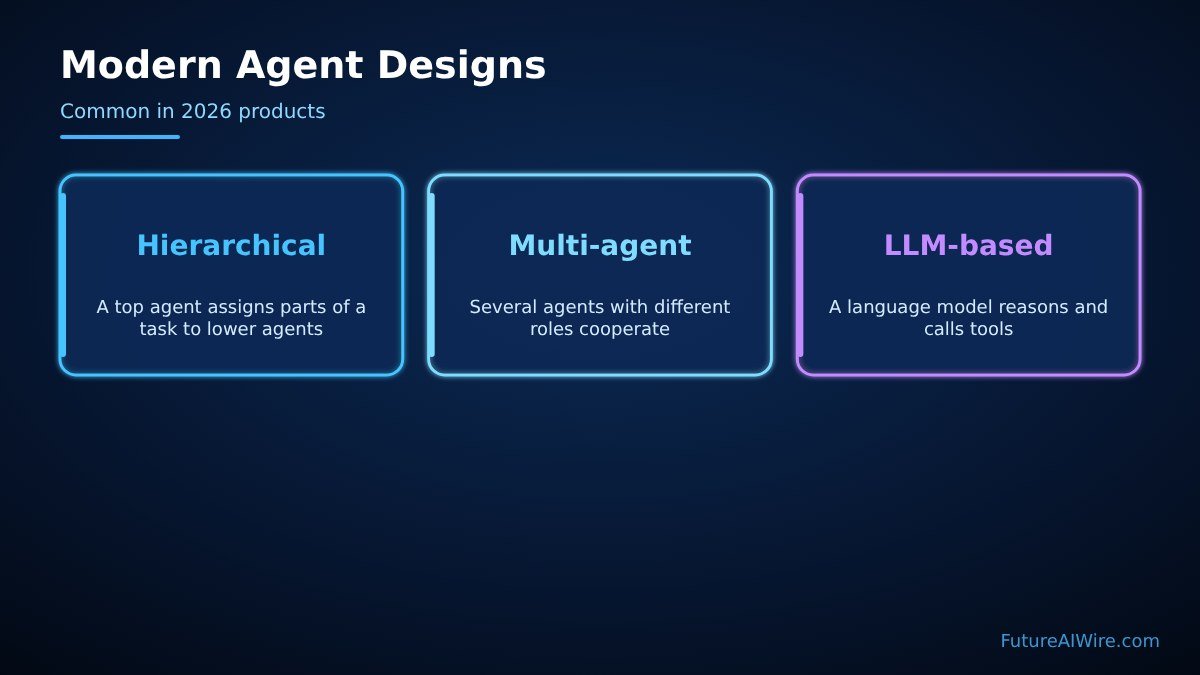
- Hierarchical agents: a top-level agent splits a task and assigns parts to lower-level agents.
- Multi-agent systems: several agents with different roles work together or negotiate. See the guide to multi-agent systems.
- LLM-based agents: a large language model acts as the reasoning engine, connected to tools, memory and instructions. These power most coding, research and assistant products today.
Agents can also talk to each other through standards such as the A2A protocol, and connect to tools through the Model Context Protocol.
Comparison Table: Which Type of AI Agent Fits Which Task?
| Agent type | Memory | Plans ahead | Learns | Typical use |
|---|---|---|---|---|
| Simple reflex | No | No | No | Rule-based alerts, filters |
| Model-based reflex | Yes | No | No | Robot vacuums, monitoring |
| Goal-based | Yes | Yes | No | Route planning, scheduling |
| Utility-based | Yes | Yes | Sometimes | Pricing, dispatch, trading |
| Learning | Yes | Often | Yes | Recommendations, games |
| LLM-based | Yes (context and memory tools) | Yes | Through updates and feedback | Coding, support, research |
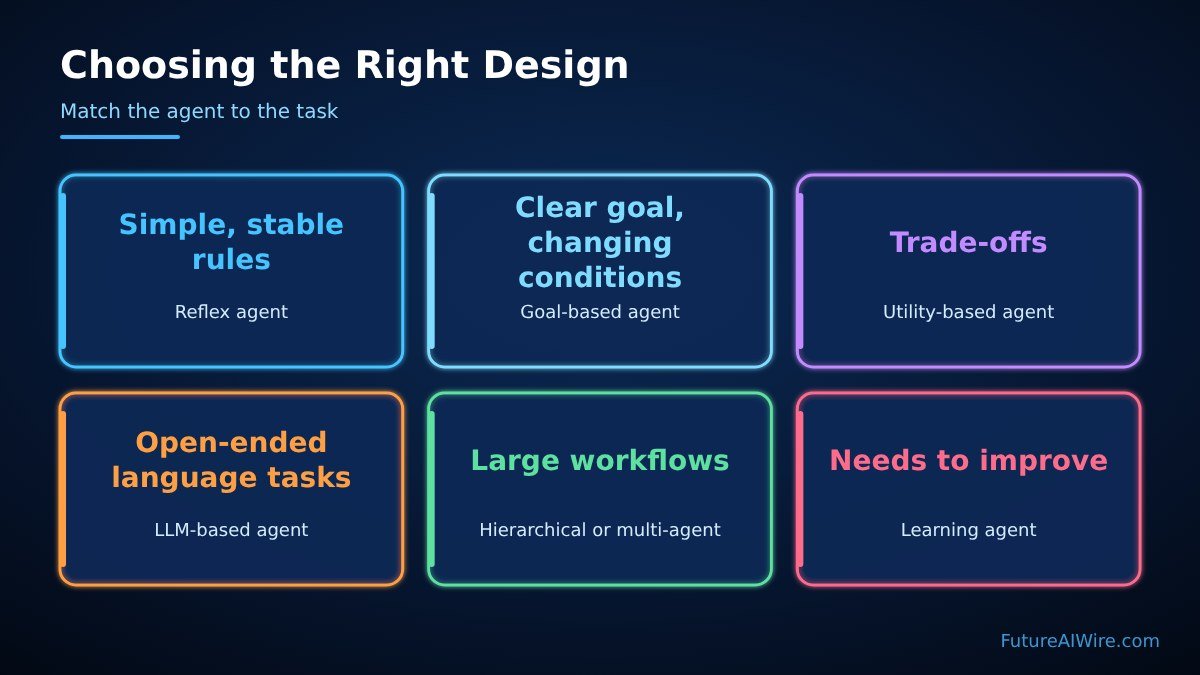
How to Choose an Agent Type
- Stable, simple rules: a reflex agent is cheaper and easier to test.
- Clear goal, changing conditions: a goal-based agent fits.
- Trade-offs between cost, speed and quality: use a utility-based design.
- Open-ended language tasks: an LLM-based agent with guardrails.
- Large workflows: a hierarchical or multi-agent setup.
For real-world deployments, see agentic AI examples, and for how the loop works step by step, read how AI agents work.
How the Classic Types Combine in Modern Products
Real products rarely fit one textbook category. A modern customer support agent, for example, mixes several designs at once:
- Reflex rules handle fixed policies, such as never sharing account details without verification.
- A world model keeps track of the conversation, the customer’s order history and what has already been tried.
- Goal-based planning works out the steps needed to resolve the ticket.
- Utility scoring chooses between options, such as a refund or a replacement, based on cost and customer satisfaction.
- Learning happens offline, when the company reviews outcomes and updates prompts, tools or the underlying model.
Self-driving cars follow the same pattern. They react instantly to obstacles, maintain a detailed map of their surroundings, plan a route to the destination and weigh safety, comfort and speed when choosing how to drive. Understanding each building block makes it easier to see where a system might fail and which part needs testing or human oversight.
Key Terms at a Glance
- Percept: the input an agent receives at a moment.
- Environment: everything the agent can sense and affect.
- Utility function: a score that measures how good an outcome is.
- Reinforcement learning: learning from rewards and penalties.
- Partially observable: an environment where the agent cannot see everything at once.
Conclusion
Knowing the different types of AI agents makes it easier to pick the right design. The five classic categories still explain how AI systems make decisions, from simple rules to learning from experience. Modern LLM-based and multi-agent systems blend these ideas, adding language understanding and tool use. Matching the agent design to the task keeps systems reliable and cost-effective.
Frequently Asked Questions
How many types of AI agents are there?
The classic list has five: simple reflex, model-based reflex, goal-based, utility-based and learning agents. Many guides add hierarchical, multi-agent and LLM-based agents.
What is the most common type of AI agent today?
LLM-based agents are the most common in new products, especially for coding, customer support and research tasks.
What is the difference between goal-based and utility-based agents?
A goal-based agent accepts any path that reaches the goal. A utility-based agent compares outcomes and picks the one with the highest value.
Is ChatGPT a learning agent?
ChatGPT is a language model product. It does not learn from each chat in real time, but its tool-using features act like LLM-based agents.
What is a multi-agent system?
It is a setup where several AI agents with different roles work together or compete to complete a larger task.

The Future AI Wire Editorial Team covers artificial intelligence, AI agents, agentic AI, and emerging technologies. We publish clear, research-informed explanations and practical insights to help readers understand AI developments, real-world applications, and the technologies shaping the future.