

Agentic AI examples in 2026 range from coding assistants that fix bugs on their own to shopping agents that compare and buy products, and personal assistants that manage email and bookings. What these systems share is the ability to plan steps toward a goal, use tools and act with limited human supervision.
Key Takeaways
- Agentic AI is now used in software development, customer service, commerce, finance, IT operations and research.
- The strongest use cases involve repeatable, multi-step digital tasks with clear success checks.
- Most real deployments keep a person in the loop for payments, account changes and sensitive data.
- Cost, reliability and security remain the main limits on wider use.
Table of Contents
The Short Answer
Agentic AI shows up wherever software can be given a goal and left to work through the steps. Common examples include coding agents, autonomous customer support, shopping and checkout agents, personal assistants, IT incident response, financial analysis and research agents. FutureAIWire’s guide to what agentic AI is explains the underlying idea.
12 Agentic AI Use Cases by Industry
The table below groups common AI agent examples by area. Product names are illustrative of the category rather than a ranking.
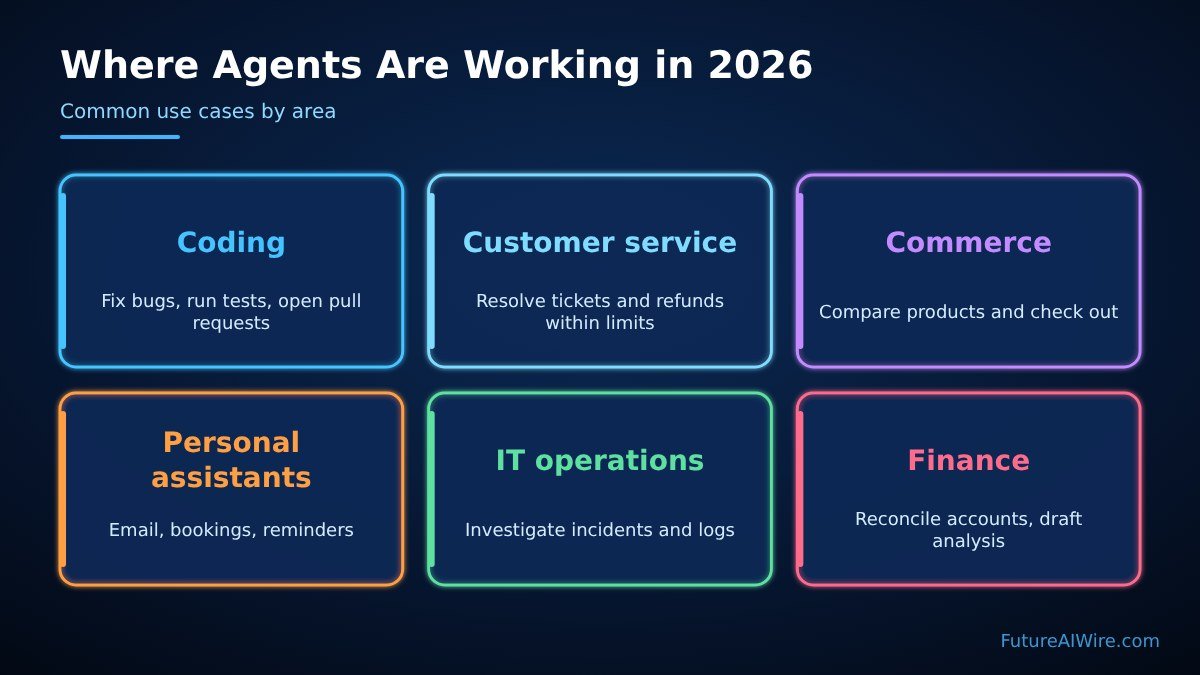
| Area | What the agent does | Human role |
|---|---|---|
| Software development | Reads a codebase, writes fixes, runs tests and opens pull requests | Reviews and merges code |
| Customer service | Resolves tickets, issues refunds within limits and updates records | Handles escalations |
| Shopping and commerce | Searches products, compares prices and completes checkout | Approves purchases |
| Personal assistants | Triages email, books events and tracks to-dos | Sets permissions |
| IT operations | Investigates incidents, reads logs and suggests or applies fixes | Approves changes |
| Cybersecurity | Triages alerts and tests systems for weaknesses | Confirms response actions |
| Finance | Reconciles accounts and drafts analysis | Signs off reports |
| Sales and marketing | Researches leads, drafts outreach and updates the CRM | Reviews messaging |
| Research | Searches sources, reads papers and writes summaries | Checks accuracy |
| Healthcare admin | Prepares prior-authorization forms and schedules | Clinicians decide care |
| Logistics | Re-routes shipments and updates inventory | Monitors exceptions |
| HR and recruiting | Screens applications and schedules interviews | Makes hiring decisions |
Coding Agents
Software development is the most mature area. Coding agents can take a task such as “fix this failing test,” explore the repository, edit files, run the test suite and repeat until it passes. Developers then review the changes. FutureAIWire’s overview of AI coding agents covers how these tools work and where they still need checking.
Customer Service Agents
Support agents go beyond answering questions. Connected to order systems and policies, they can look up an order, check eligibility, issue a refund within a set limit and close the ticket. Anything outside the rules goes to a person. This is a clear case where agentic design, rather than a simple chatbot, changes the result.
Shopping and Agentic Commerce
Shopping agents search, compare and buy on behalf of users. Retail platforms are building checkout systems that agents can use directly. Shopify said in its November 2026 earnings, as reported by CNBC, that AI-attributed orders on its platform grew 3.3 times year over year, a sign of real usage. The topic is covered in more detail in FutureAIWire’s piece on agentic commerce.
Personal Assistant Agents
Consumer assistants such as OpenAI’s Dots, xAI’s Grok Bot and Meta’s Muse aim to run in the background, handling email, reminders and bookings. They are also expensive to run, which is why companies are working to cut their compute needs.
IT and Security Operations
Agents in IT operations investigate alerts, pull logs, correlate events and propose a fix, which cuts the time engineers spend on routine incidents. In security, agents triage alerts and run approved tests. Because these agents can change systems, teams usually restrict what they can do without approval.
How These Examples of AI Agents Work
Most examples of AI agents follow the same loop:
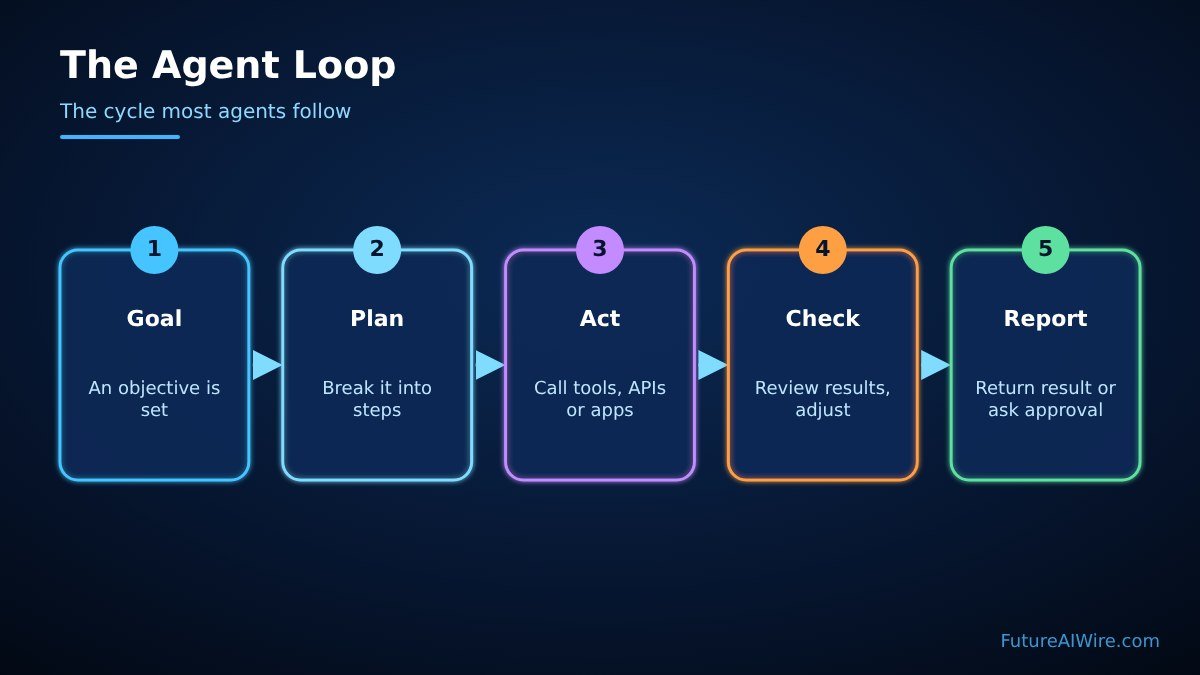
- Goal: a user or system sets an objective.
- Plan: the model breaks the goal into steps.
- Act: the agent calls tools, APIs or apps.
- Check: it reviews results and adjusts.
- Report: it returns an outcome or asks for approval.
For a deeper breakdown, see how AI agents work and agentic workflows explained.
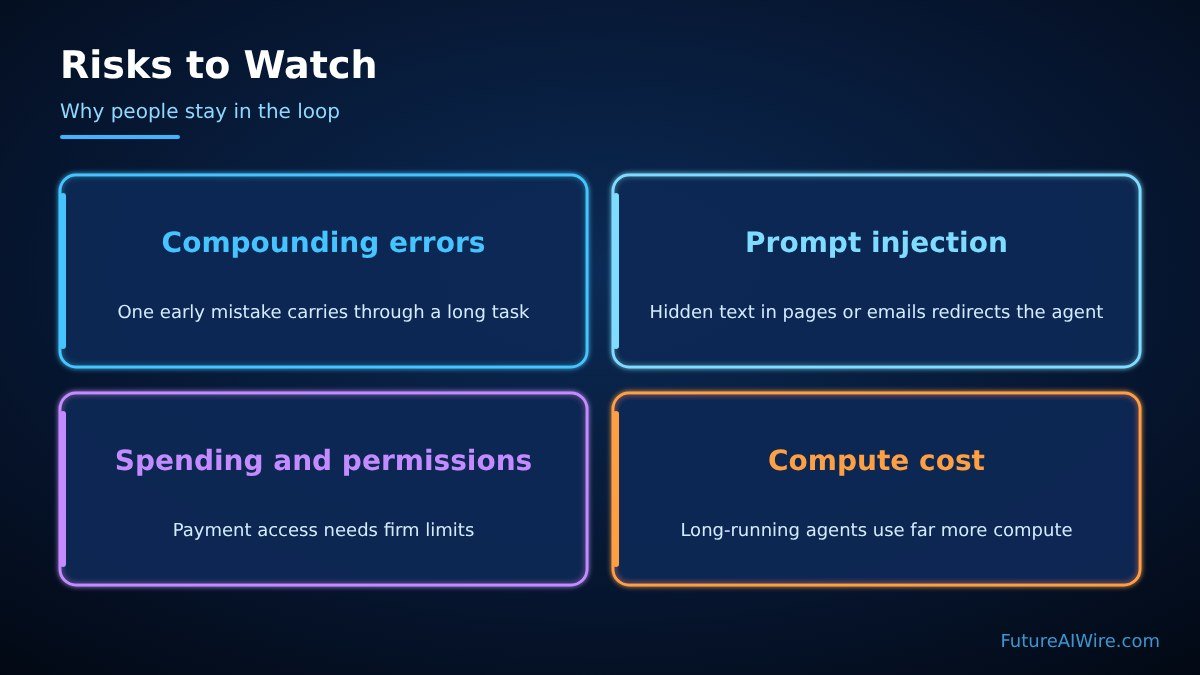
Risks to Watch
- Errors that compound: a wrong step early can carry through a long task.
- Prompt injection: malicious text in a web page or email can redirect an agent, as covered in what prompt injection is.
- Spending and permissions: agents with payment access need firm limits.
- Cost: long-running agents use far more compute than simple chat.
Key Terms at a Glance
- Agentic commerce: AI agents that shop and pay for users.
- Tool calling: a model triggering external functions such as search or checkout.
- Guardrails: rules that limit what an agent can do.
- Escalation: handing a task to a person when the agent should not proceed.
Conclusion
The clearest agentic AI examples share three traits: a defined goal, access to the right tools and a way to check results. Coding, support, commerce and IT operations lead adoption, while personal assistants are growing but costly. In every case, the safest deployments keep people in control of money, data and final decisions.
Frequently Asked Questions
What is a simple example of agentic AI?
A coding agent that is asked to fix a failing test, then edits code, runs the tests and repeats until they pass, is a simple and common example.
Is a chatbot an example of agentic AI?
Not usually. A chatbot answers messages. It becomes agentic when it can plan and take actions, such as processing a refund.
Which industries use agentic AI the most?
Software development, customer service, e-commerce, IT operations and financial services are among the earliest adopters.
Can agentic AI make purchases?
Yes, some shopping agents can complete checkout, usually with user approval and spending limits.
What are the main risks of agentic AI?
Compounding mistakes, prompt injection, overly broad permissions and high running costs are the most common concerns.

The Future AI Wire Editorial Team covers artificial intelligence, AI agents, agentic AI, and emerging technologies. We publish clear, research-informed explanations and practical insights to help readers understand AI developments, real-world applications, and the technologies shaping the future.