
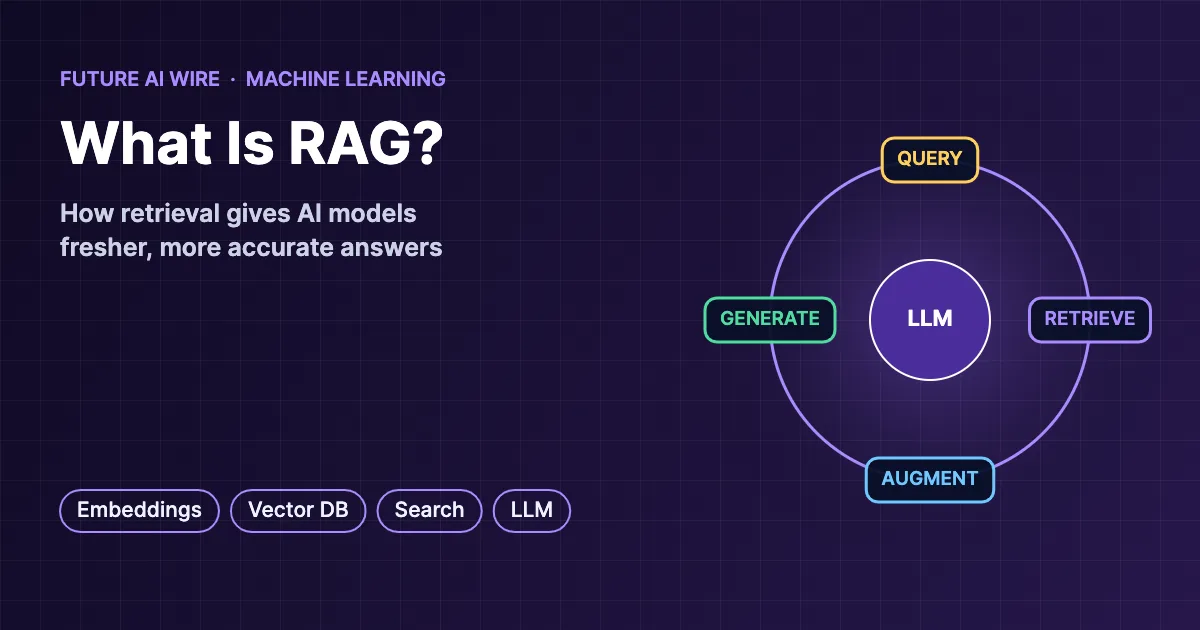
Large language models are impressive writers, but they have a well-known weakness: they only know what was in their training data, and they sometimes fill gaps with confident guesses. Businesses that want an AI assistant to answer from their own policies, product manuals, or latest reports run straight into this problem. So what is RAG, and why has it become the standard fix? In short, it is a technique that lets an AI model look up relevant information first and then write its answer using what it found.
Key Takeaways
- RAG is a method that combines search with a language model.
- Before answering, the system retrieves relevant passages from a knowledge source and adds them to the model’s prompt.
- It helps AI use current, private, or specialized information without retraining the model.
- RAG reduces, but does not eliminate, made-up answers, and makes it easier to cite sources.
- Quality depends heavily on how documents are split, indexed, searched, and ranked.
Table of Contents
What Is RAG? The Short Answer
RAG is an approach that connects a language model to an external knowledge source, such as a company wiki, a document library, a database, or the web. When a user asks a question, the system first searches that source for the most relevant pieces of text, then passes those pieces to the model along with the question. The model writes its answer grounded in the supplied material instead of relying only on what it memorized during training.
The idea was formalized in a 2020 research paper by Patrick Lewis and colleagues at Facebook AI Research, titled Retrieval-Augmented Generation for Knowledge-Intensive NLP Tasks. Since then it has become one of the most widely used patterns for building practical AI applications.
Why Language Models Need Retrieval
Three limitations of standalone models explain why the technique caught on so quickly:
- Knowledge cutoff: a model’s built-in knowledge stops at the date its training data was collected, so it cannot know about recent events, prices, or product changes.
- No access to private data: public models were never trained on a company’s internal documents, contracts, or customer records.
- Hallucinations: when a model lacks information, it may produce fluent but false statements rather than admitting uncertainty.
Retraining a model every time information changes would be slow and expensive. Retrieval offers a cheaper path: keep the model as it is and change the documents it can consult.
How RAG Works, Step by Step
A typical pipeline has two phases. The first prepares the knowledge; the second answers questions.
Phase 1: Indexing the Knowledge
- Collect documents. PDFs, web pages, help-center articles, spreadsheets, emails, or database records are gathered from approved sources.
- Split into chunks. Long documents are broken into smaller passages, often a few hundred words each, so the system can retrieve precise sections.
- Create embeddings. Each chunk is converted by an embedding model into a list of numbers that captures its meaning.
- Store in a vector database. The embeddings and original text are saved in a database designed for fast similarity search.
Phase 2: Answering a Question
- Embed the query. The user’s question is turned into an embedding in the same way.
- Retrieve. The database finds the chunks whose meaning is closest to the question.
- Rerank and filter. Optional steps reorder results by relevance and remove passages the user is not allowed to see.
- Augment the prompt. The best chunks are inserted into the prompt with instructions to answer using that material.
- Generate. The language model writes the answer, ideally with citations pointing back to the source passages.
| Component | Role | Common examples |
|---|---|---|
| Embedding model | Turns text into numerical vectors that capture meaning | OpenAI, Cohere, Google, and open-source embedding models |
| Vector database | Stores vectors and finds the closest matches quickly | Pinecone, Weaviate, Milvus, Chroma, pgvector for PostgreSQL |
| Retriever | Runs the search, sometimes mixing keyword and semantic methods | Hybrid search, BM25 keyword search, rerankers |
| Orchestration framework | Connects the pieces into a working pipeline | LangChain, LlamaIndex, Haystack |
| Language model | Reads the retrieved context and writes the answer | GPT, Claude, Gemini, Llama, Mistral models |
A Simple Example
Imagine an employee asking an internal assistant, “How many vacation days do new hires get in Canada?” Without retrieval, the model might guess a generic number. With RAG, the system searches the HR handbook, finds the paragraph on Canadian leave policy, and passes it to the model. The answer then states the correct number from the handbook and links to the exact section, so the employee can verify it.
7 Benefits of Retrieval for AI Applications
- Fresher answers: updating documents updates what the assistant knows, with no retraining.
- Private knowledge: internal content becomes searchable through natural conversation.
- Fewer made-up facts: grounding answers in real text lowers the rate of hallucinations.
- Citations: answers can point to sources, which builds trust and simplifies fact-checking.
- Access control: retrieval can respect permissions so users only see documents they are allowed to read.
- Lower cost: maintaining a document index is usually far cheaper than repeated model fine-tuning.
- Flexibility: the same model can serve many teams, each with its own knowledge base.
RAG vs Fine-Tuning vs Long Context
Retrieval is not the only way to give a model new knowledge. Teams often compare three approaches:
| Approach | How it works | Best for | Main drawback |
|---|---|---|---|
| RAG | Looks up relevant documents at question time | Changing facts, large document sets, citations | Depends on search quality |
| Fine-tuning | Further trains the model on examples | Teaching style, format, or specialized behavior | Costly to update, does not add reliable new facts easily |
| Long context | Pastes entire documents into the prompt | A few documents analyzed in depth | Expensive and slow with large volumes |
In practice, these methods are often combined. A model might be fine-tuned for tone, use retrieval for facts, and take advantage of a long context window to read several retrieved documents at once.
Types of RAG Systems
Basic RAG
The simplest version retrieves a fixed number of chunks by similarity and passes them to the model. It is quick to build and works well for clean, well-organized documents.
Advanced RAG
More mature systems add hybrid search that blends keyword and semantic matching, rerankers that score results more precisely, query rewriting that clarifies vague questions, and metadata filters for dates, departments, or document types.
GraphRAG
Some teams organize knowledge as a graph of entities and relationships, such as people, products, and contracts. Graph-based retrieval helps answer questions that require connecting facts spread across many documents. Microsoft Research has published work on this approach under the name GraphRAG.
Agentic RAG
In agentic setups, an AI agent decides when to search, which sources to query, and whether the results are good enough, sometimes running several searches before answering. This connects retrieval with the broader ideas covered in AI agents explained and agentic workflows explained. Agents can also reach data sources through standards such as the Model Context Protocol.
A Brief History of Retrieval in AI
Combining search with language systems is older than today’s chatbots. Question-answering research in the 2010s already paired document retrieval with reading-comprehension models that extracted answers from passages. The 2020 paper from Facebook AI Research connected a neural retriever with a text generator and trained them to work together, which gave the technique its now-famous name. Around the same period, Google researchers published REALM, another influential approach that built retrieval into language model pre-training.
The idea exploded in popularity after ChatGPT launched in late 2022, when companies rushed to build assistants that could answer from their own documents. Vector databases, embedding services, and orchestration frameworks grew rapidly to meet that demand. Today, retrieval is built into many mainstream AI products, often invisibly, whenever an assistant reads uploaded files, searches a connected drive, or browses the web before responding.
Common Use Cases
- Customer support: assistants answer from help-center articles, manuals, and past tickets.
- Internal knowledge search: employees query policies, wikis, and project documents in plain language.
- Legal and compliance: teams search contracts and regulations with cited passages.
- Healthcare and research: clinicians and scientists summarize literature and guidelines, with expert review.
- Sales enablement: reps pull accurate product specs, pricing rules, and case notes quickly.
- AI search engines: many answer engines retrieve live web results and cite them, a closely related pattern.
Challenges and Limitations
- Bad retrieval means bad answers: if the search step misses the right passage, the model cannot use it.
- Chunking trade-offs: chunks that are too small lose context; chunks that are too large add noise.
- Conflicting or outdated documents: the system may retrieve old versions unless content is maintained.
- Remaining hallucinations: models can still misread or overstate retrieved text.
- Security risks: documents can contain hidden instructions that try to manipulate the model, a form of prompt injection.
- Permissions: without careful filtering, a user could receive information from documents they should not access.
How to Evaluate a RAG System
Teams typically measure two things separately: whether retrieval finds the right material, and whether the answer stays faithful to it. Useful metrics include retrieval precision and recall, answer relevance, faithfulness to the sources, and citation accuracy. Open-source evaluation tools such as Ragas, along with test sets of real user questions and expected answers, help catch regressions whenever documents, prompts, or models change.
Best Practices for Building RAG
- Start with clean, current, and well-structured documents.
- Experiment with chunk size and overlap rather than relying on defaults.
- Use hybrid search and a reranker for better relevance.
- Store metadata such as dates, owners, and access levels for filtering.
- Instruct the model to answer only from the provided context and to say when information is missing.
- Show citations so users can verify answers.
- Log questions and failures to keep improving the knowledge base.
Why RAG Matters for AI Search and Brand Visibility
Retrieval is not only an internal engineering pattern. Many AI answer engines, including Perplexity, Google’s AI Overviews, ChatGPT search, and Microsoft Copilot, use a similar process: they search the web, select relevant pages, and write an answer that cites some of them. This has major implications for publishers and brands.
Content that is easy to retrieve and quote tends to have a better chance of being used in these answers. Clear headings, direct definitions, well-labeled tables, accurate facts, and consistent brand information all make passages easier for a retrieval system to match and for a model to summarize faithfully. This is part of what marketers now call generative engine optimization (GEO) and answer engine optimization (AEO). No technique guarantees inclusion, but understanding how retrieval works helps explain why well-structured, trustworthy pages are more likely to be surfaced.
How to Choose RAG Tools
The tooling landscape is crowded, and the right stack depends on scale, budget, and existing infrastructure. A few practical questions narrow the options:
- Managed or self-hosted? Managed vector databases reduce operational work, while self-hosted options such as pgvector or Milvus give more control over data location and cost.
- Existing database? Teams already running PostgreSQL, Elasticsearch, or OpenSearch can often add vector search to systems they know well.
- Framework or custom code? LangChain, LlamaIndex, and Haystack speed up prototyping, while some production teams later replace parts with simpler custom code.
- Built-in platform features: major cloud and model providers now offer file search and knowledge-base features that handle chunking and retrieval automatically, which can be enough for many use cases.
- Security and compliance: enterprise projects should check encryption, access controls, audit logs, and data residency options.
Real-World Pitfalls Teams Run Into
Projects that look excellent in a demo often struggle once real users arrive. Common surprises include questions phrased very differently from the documents, tables and scanned PDFs that do not convert cleanly to text, duplicate documents with conflicting versions, and users asking about topics the knowledge base never covered. The fix is rarely a new model. More often it is better document cleanup, smarter chunking, clearer instructions for the model to admit when it does not know, and a feedback loop where unanswered questions lead to new or improved content.
Key Terms at a Glance
- Embedding: a numerical representation of text that captures meaning, allowing similar ideas to be found even with different wording.
- Vector database: a database optimized for storing embeddings and finding the most similar ones.
- Chunking: splitting documents into smaller passages for indexing and retrieval.
- Reranker: a model that reorders search results by how well they match the question.
- Grounding: tying a model’s answer to specific source material.
- Context window: the maximum amount of text a model can read in one request.
- Hallucination: a confident but incorrect statement produced by an AI model.
Conclusion
RAG has become the default way to make language models useful with real-world, changing, and private information. By searching first and writing second, it gives AI assistants a reliable memory that can be updated as easily as a document library. It is not a cure-all, and its quality depends on careful data preparation and testing, but for most organizations it is the most practical path from a general-purpose model to a trustworthy, specialized assistant.
Frequently Asked Questions
What does RAG stand for?
It stands for retrieval-augmented generation. The name describes the process: retrieve relevant information, add it to the prompt, then generate an answer.
Does RAG stop AI hallucinations completely?
No. It reduces them by supplying relevant facts, but a model can still misinterpret sources or answer beyond them. Citations and evaluation help catch these errors.
Is RAG better than fine-tuning?
They solve different problems. Retrieval is better for adding and updating knowledge, while fine-tuning is better for shaping style, format, or specialized behavior. Many systems use both.
Do RAG systems need a vector database?
Not always. Small projects can use simple in-memory search or traditional keyword search. Vector databases become valuable as document volumes and performance needs grow.
Can RAG use live web data?
Yes. Some systems retrieve from search engines or APIs at question time, which keeps answers current. Web content should be treated with caution because it can be inaccurate or manipulated.
How much does it cost to build a RAG system?
Costs vary widely. A prototype using managed services can be inexpensive, while enterprise systems add expenses for data preparation, hosting, security, and ongoing evaluation.
Can RAG work with images, audio, or video?
Yes. Multimodal retrieval systems create embeddings for images, transcripts, and video frames, allowing a model to find and reason over non-text content. Text remains the most mature and widely used option.
Is retrieval only useful for large companies?
No. Freelancers, small teams, and individual researchers use simple versions every day, for example by uploading files to an AI assistant that searches them before answering.

The Future AI Wire Editorial Team covers artificial intelligence, AI agents, agentic AI, and emerging technologies. We publish clear, research-informed explanations and practical insights to help readers understand AI developments, real-world applications, and the technologies shaping the future.