
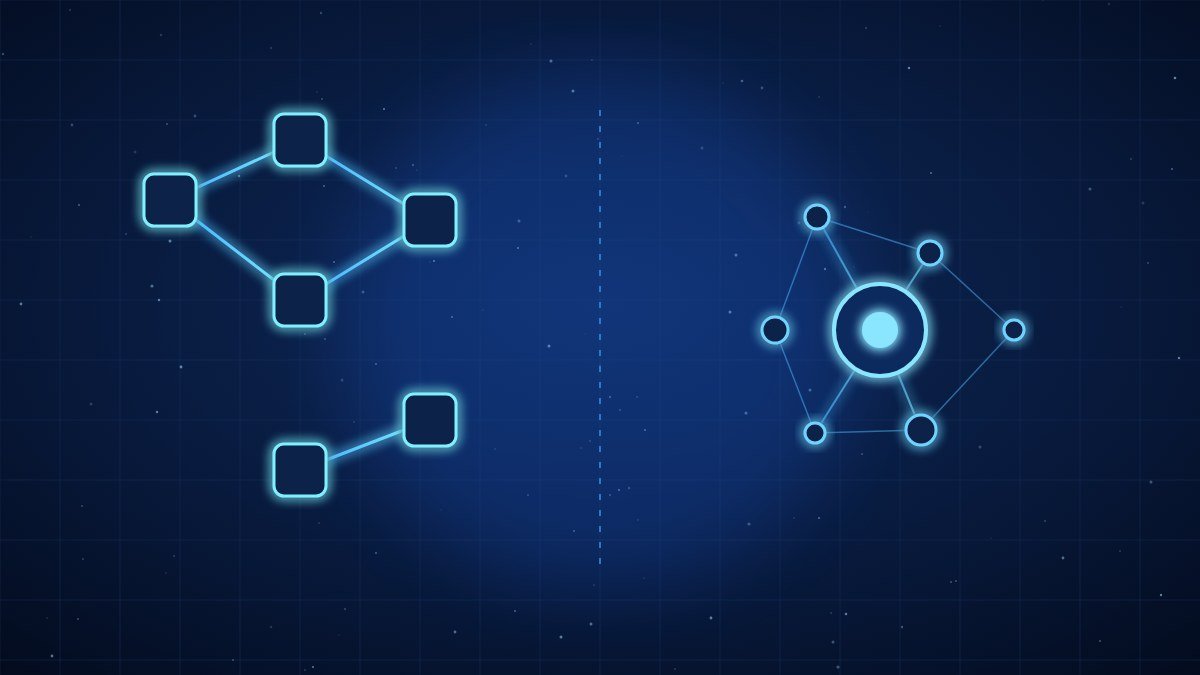
In the LangGraph vs CrewAI decision, LangGraph suits teams that want fine-grained control over every step, state change and branch of an agent workflow, while CrewAI suits teams that want to stand up a group of role-based agents quickly with less code. Both are open-source Python frameworks for building AI agents, but they start from different mental models: LangGraph thinks in graphs, CrewAI thinks in teams.
This comparison explains how each framework works, where each shines and how to pick between them. For the wider field, including AutoGen and other options, see AI Agent Frameworks Compared.
Table of Contents
Key Takeaways
- LangGraph models an agent as a state graph of nodes and edges, giving precise control over flow and loops.
- CrewAI models a system as a crew of agents with roles, goals and tasks, which makes multi-agent setups quick to write.
- LangGraph is maintained by LangChain Inc.; CrewAI is maintained by CrewAI Inc. and runs independently of LangChain.
- LangGraph generally has the steeper learning curve but more explicit control for production edge cases.
- Many teams prototype with CrewAI and move complex, long-running workflows to LangGraph, or vice versa.
LangGraph vs CrewAI at a Glance
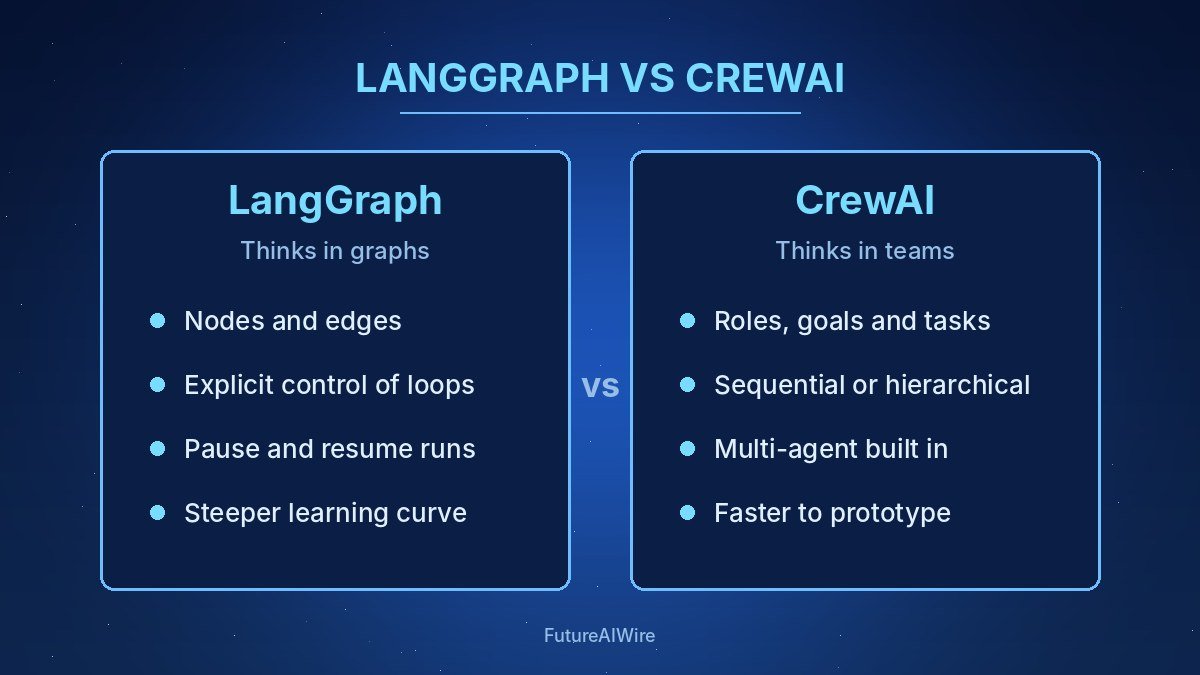
In LangGraph vs CrewAI, the core difference is the level of abstraction. LangGraph exposes the workflow as a graph that developers wire up by hand, while CrewAI hides much of that wiring behind roles and tasks.
| Factor | LangGraph | CrewAI |
|---|---|---|
| Core idea | Stateful graph of nodes (steps) and edges (transitions) | Crew of role-based agents working on tasks |
| Control | Explicit, low-level control of flow, loops and branching | Higher-level; process type (sequential or hierarchical) handles flow |
| Multi-agent | Supported through supervisor and network graph patterns | Built in from the start |
| Deterministic workflows | Native via graph structure | Via CrewAI Flows, which add event-driven steps |
| State and persistence | Checkpointers save state for resuming and time-travel debugging | Built-in memory options for short-term, long-term and entity memory |
| Human in the loop | Interrupts can pause a graph for approval | Human input can be requested on tasks |
| Ecosystem | Integrates with LangChain tools and LangSmith tracing | Own tool library; works with many LLM providers |
| Learning curve | Steeper | Gentler |
What Is LangGraph?
LangGraph is an open-source library from LangChain Inc. for building stateful, multi-step agent applications as graphs. Each node is a function, such as a model call or a tool call, and each edge decides what runs next, including conditional edges that branch on the model’s output.
A shared state object flows through the graph, and checkpointers can save that state after each step. That design makes it possible to pause a run, wait for a human, resume later, or replay earlier steps when debugging. LangGraph is available in Python and JavaScript, and LangChain offers a managed platform for deploying graphs alongside LangSmith for tracing and evaluation.
What Is CrewAI?
CrewAI is an open-source Python framework, created by João Moura, for orchestrating teams of AI agents that each have a role, a goal and a backstory. Developers define agents, assign them tasks and choose a process, either sequential, where tasks run in order, or hierarchical, where a manager agent delegates.
Alongside Crews, CrewAI offers Flows, an event-driven layer for adding precise, deterministic control around agent teams. The company also sells an enterprise platform for deploying and monitoring crews. CrewAI was rebuilt to run independently of LangChain, which keeps its dependency footprint smaller.
How the Two Frameworks Differ in Practice
Control Versus Speed
LangGraph trades speed of setup for control. A developer decides exactly which node runs after which, how many times a loop may repeat and what happens on failure. CrewAI trades some of that control for speed: a working three-agent research team can be expressed in a few dozen lines.
State, Memory and Long-Running Jobs
LangGraph’s checkpointing is a strong fit for long-running or interruptible jobs, such as approval workflows that wait hours for a person. CrewAI’s memory system focuses on helping agents recall context across tasks and runs. Readers interested in the wider topic can explore how AI agents work with memory and tools.
Multi-Agent Design
CrewAI was designed around multiple collaborating agents, so roles and delegation feel natural. LangGraph supports the same multi-agent system patterns, such as a supervisor routing work to specialists, but the developer builds them as graphs.
Debugging and Observability
LangGraph pairs closely with LangSmith, which records each step for inspection. CrewAI provides its own tracing in its platform and integrates with third-party observability tools. In both cases, step-level logs are essential for understanding why an agent made a decision.
When to Choose LangGraph
- The workflow has complex branching, retries or loops that must be predictable.
- Runs need to pause for human approval and resume reliably.
- The team already uses LangChain components or LangSmith.
- Compliance requires a clear, auditable map of every possible path.
When to Choose CrewAI
- The problem maps naturally to roles, such as researcher, writer and reviewer.
- The goal is a fast prototype or internal tool with modest complexity.
- The team prefers readable, configuration-style code, including YAML-defined agents and tasks.
- A smaller dependency footprint outside the LangChain ecosystem is preferred.
A Simple Way to Decide
- Sketch the workflow on paper. If it looks like a flowchart with many decision points, lean towards LangGraph.
- If it looks like an org chart of specialists passing work along, lean towards CrewAI.
- Build a small proof of concept of the hardest step in both, which usually takes a day or two.
- Compare reliability, cost per run and how easy the trace is to read.
- Review security before connecting either framework to real systems; the AI Agent Security guide lists the main risks.
Key Terms Glossary
- Node: A single step in a LangGraph workflow, such as a model call or tool call.
- Edge: A connection that decides which node runs next; conditional edges branch on results.
- Checkpointer: A LangGraph component that saves state so runs can pause, resume or be replayed.
- Crew: A CrewAI group of agents working together on a set of tasks.
- Flow: CrewAI’s event-driven layer for structured, deterministic orchestration.
- Hierarchical process: A CrewAI mode in which a manager agent assigns and reviews work.
- LangSmith: LangChain’s platform for tracing, evaluating and monitoring LLM applications.
Frequently Asked Questions
Is CrewAI built on LangChain?
No. CrewAI originally used LangChain components but was rebuilt as an independent framework, though it can still work alongside LangChain tools.
Is LangGraph harder to learn than CrewAI?
Yes, for most developers. LangGraph asks developers to think in states, nodes and edges, while CrewAI starts from familiar ideas like roles and tasks.
Which framework is better for production?
Both are used in production. LangGraph is often preferred for complex, long-running workflows that need exact control, while CrewAI is popular for role-based automations that need to ship quickly.
Can LangGraph and CrewAI be used together?
Yes. A team can call a CrewAI crew from inside a LangGraph node, or use LangGraph for one service and CrewAI for another, although mixing frameworks adds maintenance work.
Are both frameworks free?
Both core libraries are open source and free to use. Their companies charge for optional managed platforms, and model API usage is billed separately by the model provider.
Which LLMs do they support?
Both support major providers, including OpenAI, Anthropic and Google models, as well as locally hosted open models through compatible integrations.
Related Reading on Future AI Wire
- AI Agent Frameworks Compared: How to Choose in 2026
- Multi-Agent Systems Explained
- Agentic Workflows Explained
Sources and further reading: LangGraph documentation; CrewAI documentation; CrewAI on GitHub; LangGraph on GitHub.
The Future AI Wire Editorial Team covers artificial intelligence, AI agents, agentic AI, and emerging technologies. We publish clear, research-informed explanations and practical insights to help readers understand AI developments, real-world applications, and the technologies shaping the future.