
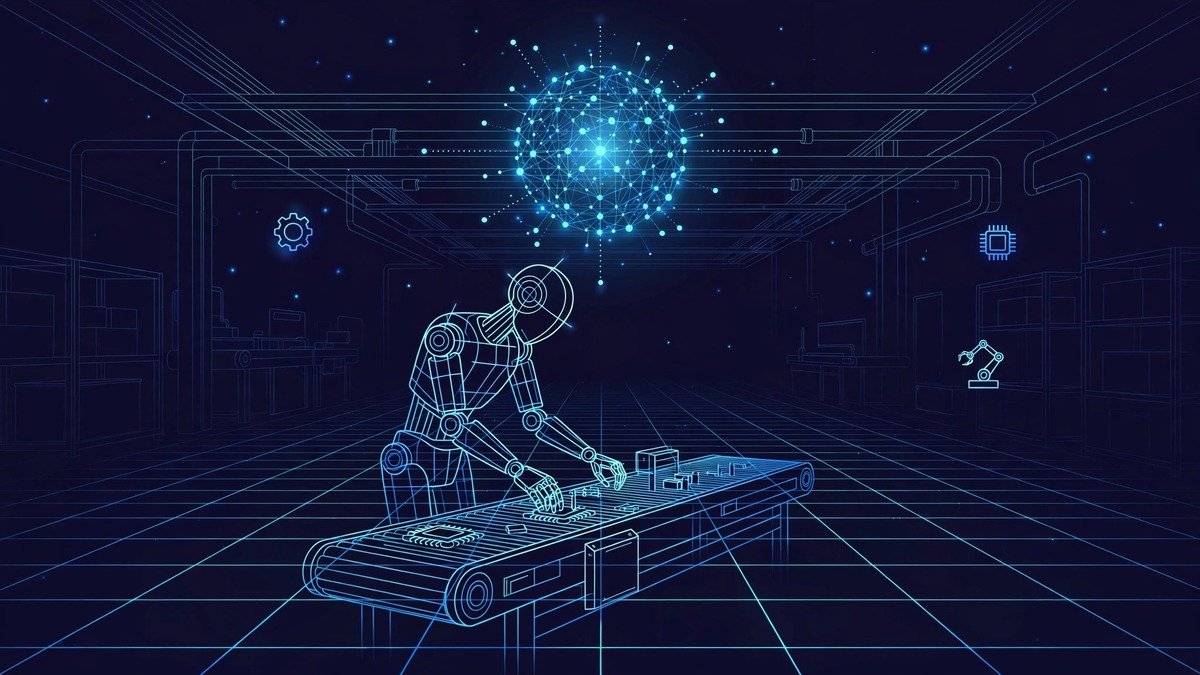
The latest ai manufacturing news on 13 November 2026 centres on a humanoid robot learning a real packing job inside an electronics factory. ASUS introduced Gallop, a humanoid robot that packs motherboard accessories at an ASUS group plant, with customer pilots planned for 2027. Daim Technology also signed an agreement with Intel Korea to develop dark-factory technology for plants that run with minimal human involvement.
This article reflects reporting available as of 13 November 2026.
Key Takeaways
- ASUS Gallop packs 15 motherboard accessories at an electronics plant, targeting 99.5% success within 20 seconds per board.
- Gallop learns by watching skilled workers, practising in simulation, and receiving guidance through virtual reality.
- Customer pilots are planned for 2027, with market availability targeted for the second half of 2028.
- Daim Technology and Intel Korea signed an agreement on 12 November to build an autonomous operating system for an entire plant.
- Gallop runs on a single NVIDIA Jetson AGX Thor computer, and its four-layer AI design allows newer models to replace older ones without a rebuild.
Table of Contents
The Short Answer
Factory AI moved from demonstration videos to real production work on 13 November 2026. ASUS showed a humanoid robot doing a genuine packing job at a real workstation, while Daim Technology and Intel Korea agreed to develop software that runs a whole plant as one connected system.
The Jetson Thor computer inside Gallop also connects the story to ai compute news, because factory robots depend on compact on-board computing.
What the Latest AI Manufacturing News Means for Factories
The latest factory developments point in one direction: connected systems instead of isolated machines. A robot that packs parts is useful. A plant in which robots, sensors, and scheduling software share the same plan is a larger change. ASUS tests one workstation. Daim Technology and Intel aim at the full plant.
What Is Gallop, and What Job Does It Do?
Gallop is the first humanoid robot from ASUS, built by its Humanoid Robotics business unit. Its first job sits at a motherboard accessory packing station inside an ASUS group electronics manufacturing services plant. The station holds 15 small parts, many in thin, clear bags, and takes about 20 seconds per board. ASUS set the same standard for the robot as for a person: 99.5% success within 20 seconds.
ASUS chose the station because the work is hard for a simple gripper. Small, thin, and soft parts demand touch and care. The company also applies a strict test: a robot must take on most of a job, or the gain is limited.
How Does Gallop Learn a Factory Job?
Gallop learns in five stages. It starts from leading open models that already understand how hands and objects behave. Experienced workers wear a small head camera, with consent, so the robot can study the job. Simulation generates variations of each example. An operator in a virtual reality headset and gloves then guides the robot. Once deployed, the robot records experience that feeds back into training.
The modular design also links the story to ai models news, because ASUS states that new models arrive every few months and can be swapped in without rebuilding the robot. The four layers inside Gallop are planning, supervision, skills, and control. A planner breaks a job into steps. A supervisor checks every step and re-plans when something goes wrong. A control layer moves the arms and hands precisely and stops instantly if anything is wrong.
Why Are Humanoid Robots Moving Into Electronics Plants?
Most factories are built around people. Stations, tools, and trays are sized for human hands. Fixed automation handles high-volume, unchanging tasks well, but struggles when production runs change. A robot with two arms and dexterous hands can work at the same stations and tools, so a factory does not have to be rebuilt around it.
ASUS also builds computing hardware and owns electronics manufacturing plants for testing. Real parts and real quality rules shape the robot from the start. Agent-style software that plans, checks, and corrects each step fits the same pattern, with supervision built into the loop.
What Did Daim Technology and Intel Agree on 13 November?
Daim Technology said on 13 November that it had signed a memorandum of understanding with Intel Korea. The agreement covers AI-based dark factory technology. A dark factory is a plant that runs with minimal human involvement. The signing took place on 12 November, according to Seoul Economic Daily.
Under the agreement, Daim Technology plans to link Intel AI and computing technology to its robot integration control and factory operations software. The work covers managing different robots as a single system, factory simulation, and AI agents in plant operations. Intel will provide Core Ultra and Xeon processors, Arc GPUs, and OpenVINO, its toolkit for optimising AI models.
The agreement also belongs in ai infrastructure news, because it links server and edge computing to factory software. The two companies will run a joint proof of concept in an environment resembling a real manufacturing site. The work will use Kairoverse, Daim Technology’s platform for commercialising dark factories.
Hwang Il-hoe, chief technology officer at Daim Technology, called the goal an entire plant “connected as one system and operated intelligently.” The statement is a company claim about the project goal, not a proven result.
How Do Smart Factories Combine Robots, Vision and Forecasting?
A smart factory combines several AI tools at once. Robots move parts. Machine vision checks quality. Sensors watch equipment health. Forecasting software plans materials and production. The value comes from the combination: a vision check that finds a defect, a schedule that adjusts, and a robot that keeps working.
| Approach | Main factory job | Main limit |
|---|---|---|
| Fixed industrial robots | Fast, repeated tasks on a set line | Poor fit when runs change often |
| Collaborative robots | Shared tasks beside workers | Limited strength and reach |
| Humanoid robots | Varied jobs at human-sized stations | Still in testing |
| Machine-vision inspection | Finding defects and checking parts | Needs clean data and good lighting |
Predictive maintenance adds a further layer. Sensors track vibration, heat, and sound. Software looks for patterns that precede failure. Maintenance then happens before a breakdown. The approach depends on data quality: poor sensor data produces poor warnings.
What Steps Does a Factory Pilot Follow?
- A factory team picks one station with a clear task, a measurable standard, and hard-to-handle parts.
- Skilled workers demonstrate the task while cameras and sensors record each step.
- Simulation creates variations of the task, so the system learns to cope with small changes.
- A supervised trial runs on the real line, and the team measures results against the human standard.
What Limits Should Factory Leaders Watch?
Integration cost is the first limit. New robots must fit old lines, old software, and existing safety systems. No price for Gallop has been confirmed, so cost claims would be guesswork. Safety is the second limit. A robot that shares space with people needs reliable stops and tested failure modes. Workforce impact is the third limit. ASUS states that Gallop targets repetitive, physically demanding stations that are hardest to staff, and that the people who teach it move into setup, supervision, and improvement roles. That outcome is a company claim, and it depends on training and redeployment in practice. Security and supervision controls form a fourth limit: connected factory systems need access rules and monitoring.
Key Terms at a Glance
Physical AI: AI that sees, decides, and moves a machine in the real world.
Dark factory: A plant designed to run with minimal human involvement.
Cobot: A collaborative robot built to work beside people.
Machine vision: Camera and software systems that inspect parts and spot defects.
Predictive maintenance: The use of sensor data to spot early signs of equipment failure.
Frequently Asked Questions
What is ASUS Gallop?
Gallop is the first humanoid robot from ASUS, built to do real factory work at human-sized stations. Its first job is packing motherboard accessories at an ASUS group electronics manufacturing services plant.
When will Gallop reach customers?
Customer pilots are planned for 2027, and market availability is targeted for the second half of 2028, according to ASUS. A demonstration for customers is planned at Computex 2027.
What is a dark factory?
A dark factory is a plant that runs with minimal human involvement, with robots and equipment linked into one intelligently operated system. In ai infrastructure news terms, the Daim-Intel project fits that definition, linking server and edge computing to factory software.
How does Gallop learn new tasks?
Gallop learns by watching skilled workers, practising variations in simulation, and receiving hands-on guidance through virtual reality. In ai models news terms, it starts from leading open models and swaps in newer models as they arrive.
What computing powers Gallop?
A single NVIDIA Jetson AGX Thor computer inside the robot powers Gallop, using standard robotics software. For readers tracking ai compute news, the detail matters because the whole four-layer system runs on that one computer.
Related Reading on Future AI Wire
- What Is an Agentic Browser? Computer-Use AI Explained
- AI Agent Use Cases Across Industries
- AI Chips News Today
Sources
- ASUS Press Room, “Factory-Proven Physical AI: Why ASUS Is Building a Humanoid Robot,” 13 November 2026, press.asus.com
- Interesting Engineering, “ASUS builds humanoid robot to pack tiny parts in electronics factories,” 13 November 2026, interestingengineering.com
- Seoul Economic Daily, “Daim Technology, Intel Partner on Dark Factory Technology,” 13 November 2026, en.sedaily.com

The Future AI Wire Editorial Team covers artificial intelligence, AI agents, agentic AI, and emerging technologies. We publish clear, research-informed explanations and practical insights to help readers understand AI developments, real-world applications, and the technologies shaping the future.