
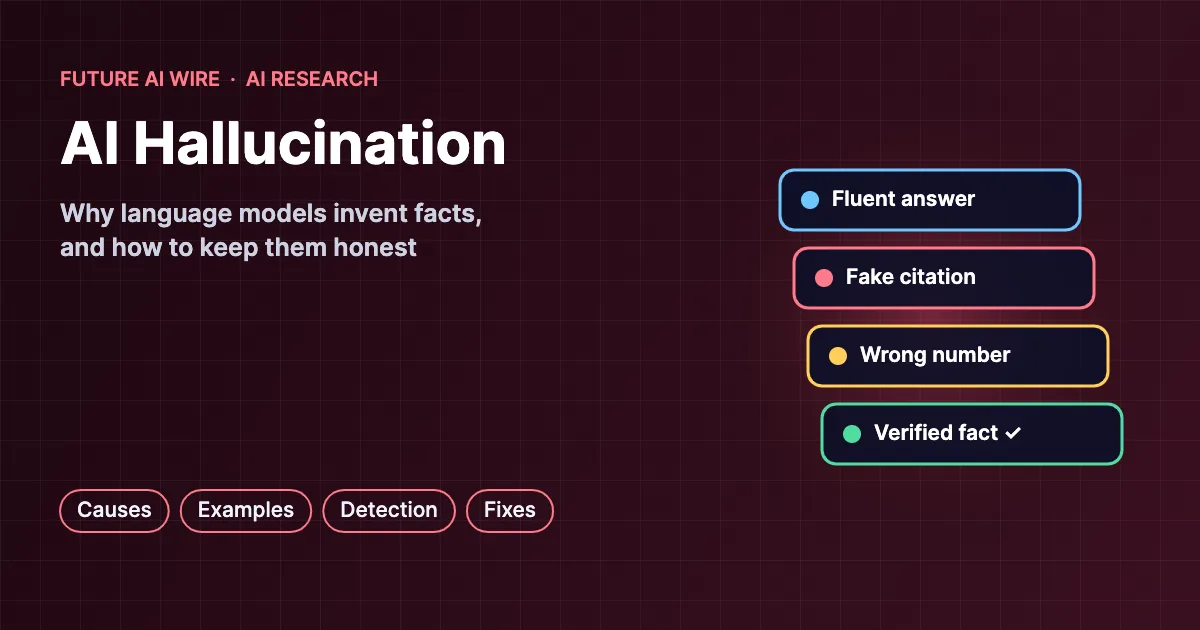
Anyone who has used a chatbot for long enough has seen it happen: a confident, well-written answer that turns out to be wrong. It might cite a study that does not exist, invent a quote, or give a precise statistic with no basis at all. This behavior, widely known as AI hallucination, is one of the biggest obstacles to trusting language models with important work. Understanding why it happens is the first step toward reducing it.
Key Takeaways
- A hallucination is output from an AI model that sounds plausible but is false, unsupported, or invented.
- It happens because language models generate likely-sounding text rather than looking up verified facts.
- Common forms include fake citations, wrong numbers, invented people or events, and flawed reasoning.
- Grounding answers in sources, allowing the model to say “I don’t know,” and human verification reduce the risk.
- No current method eliminates hallucinations completely, so high-stakes uses need checks.
Table of Contents
What Is an AI Hallucination?
In the context of artificial intelligence, a hallucination is content generated by a model that is not supported by its training data, the information it was given, or reality. The term borrows loosely from human psychology, though the comparison is imperfect: models do not perceive anything. Some researchers prefer words such as “confabulation” or simply “fabrication,” because the model is filling gaps with plausible-sounding material.
What makes these errors dangerous is their style. A hallucinated answer usually reads exactly like a correct one, with the same confident tone, formatting, and detail. Without independent checking, readers often cannot tell the difference.
Why Do Language Models Hallucinate?
They Predict Text, Not Truth
Large language models (LLMs) are trained to predict the next word, or token, in a sequence based on patterns in huge amounts of text. That training makes them excellent at producing fluent, coherent language. It does not give them a built-in database of verified facts or a reliable sense of when they are uncertain. When the patterns point toward a plausible answer, the model produces it, whether or not it is true.
Gaps and Errors in Training Data
Models learn from data that is incomplete, outdated, and sometimes wrong. Rare facts, niche topics, recent events, and specialized fields are especially likely to be poorly represented, so the model has less to draw on and more room to improvise.
Training That Rewards Guessing
Research published by OpenAI in 2025, Why Language Models Hallucinate, argues that common training and evaluation methods reward models for guessing rather than admitting uncertainty. Much like a student taking a multiple-choice test with no penalty for wrong answers, a model that always guesses can score better on benchmarks than one that says “I don’t know.” The authors suggest changing evaluations to reward appropriate expressions of uncertainty.
Ambiguous or Leading Prompts
Questions that assume a false premise, such as asking for details of an event that never happened, can push a model to invent supporting details. Vague prompts also leave more room for the model to fill in blanks.
Long Reasoning Chains
In multi-step tasks, a small early mistake can carry through every later step. This is a particular concern for AI agents that take actions based on their own outputs, as described in AI agents explained.
Common Types of Hallucinations
| Type | What it looks like | Example |
|---|---|---|
| Factual error | A wrong fact stated confidently | An incorrect date, name, or number |
| Fabricated source | Citations, links, or quotes that do not exist | A realistic-looking journal article with invented authors |
| Unfaithful summary | Adds or changes details from the provided text | A meeting summary listing a decision that was never made |
| Reasoning error | Logical steps that sound valid but are not | A math solution with a hidden mistake in the middle |
| Multimodal error | Describing objects or text not present in an image | Reading words on a sign that are not there |
Researchers also distinguish between intrinsic hallucinations, which contradict the source material the model was given, and extrinsic hallucinations, which add claims that cannot be verified from that material.
Real-World Examples
- Fake legal citations: in the 2023 U.S. case Mata v. Avianca, lawyers submitted a court filing containing case citations generated by ChatGPT that did not exist, and the court sanctioned them. Similar incidents have since been reported in courts around the world.
- Customer service promises: in 2024, a Canadian tribunal ruled that Air Canada was responsible for incorrect refund information its website chatbot gave a customer, rejecting the idea that the chatbot was a separate entity.
- Product demos: when Google introduced its Bard chatbot in 2023, a promotional example contained an inaccurate claim about the James Webb Space Telescope, drawing wide attention to the problem.
These cases share a lesson: organizations remain accountable for what their AI systems say.
How to Spot a Hallucination
- Check citations directly. Search for every cited paper, case, or article and confirm it exists and says what the answer claims.
- Be wary of very specific numbers without a named source.
- Ask the same question differently. Inconsistent answers to rephrased questions are a warning sign.
- Request sources and quotes and compare them with the original documents.
- Watch for overconfidence on niche topics, recent events, or obscure people.
It also helps to know where errors cluster. Hallucinations tend to appear more often in answers about obscure people, small companies, local details, recent news, exact quotations, statistics, and anything requiring long chains of calculation. They are less common for widely documented general knowledge. Readers who keep these patterns in mind can focus their fact-checking where it matters most instead of second-guessing every sentence. For teams, logging which kinds of questions produce the most errors creates a practical map of where extra safeguards, better source documents, or human review are needed.
9 Proven Ways to Reduce Hallucinations
- Ground answers in sources. Retrieval-based systems supply relevant documents before the model answers, so it can rely on real text rather than memory.
- Allow “I don’t know.” Instructions that explicitly permit and encourage uncertainty reduce invented answers.
- Require citations. Asking the model to quote or link the passage behind each claim makes errors easier to catch.
- Use tools for facts and math. Calculators, code execution, databases, and search are more reliable than the model’s memory.
- Write specific prompts. Clear context, constraints, and examples leave less room for guessing.
- Lower randomness for factual tasks. Reducing sampling temperature can make outputs more consistent, though it does not guarantee accuracy.
- Add verification steps. A second model pass or automated checker can compare claims against sources.
- Keep humans in the loop. Experts should review outputs in legal, medical, financial, and other high-stakes areas.
- Choose and test models carefully. Accuracy varies by model and task, so teams should evaluate options on their own real questions.
How Researchers Measure Hallucinations
Several public benchmarks track how often models produce false information. TruthfulQA tests whether models repeat common misconceptions, while OpenAI’s SimpleQA measures accuracy on short fact-seeking questions and also tracks how often a model declines to answer. Other evaluations focus on summarization faithfulness, checking whether a summary sticks to the source text. Results improve with newer models, but no widely used model scores perfectly, and performance on benchmarks does not always match performance in a specific business setting.
Why Hallucinations Matter for Businesses
For organizations, the risk goes beyond embarrassment. Incorrect outputs can lead to legal liability, financial losses, regulatory problems, and damaged customer trust. Agents that act on false information can send wrong emails, process incorrect refunds, or make poor purchasing decisions. Frameworks such as the U.S. National Institute of Standards and Technology’s AI Risk Management Framework list information integrity and accuracy among the key risks to manage when deploying generative AI.
What the Industry Is Doing About It
Model developers are attacking the problem from several directions. Training methods increasingly reward models for acknowledging uncertainty instead of guessing. Many assistants now search the web or connected files before answering and show the sources they used. Reasoning models that work through problems step by step can catch some of their own mistakes, although longer reasoning does not automatically mean fewer errors. Developers also publish system cards and evaluation results that report factual accuracy, giving buyers more information when comparing models.
On the application side, companies are adding guardrail layers that check outputs against policies and source documents before they reach users, along with monitoring tools that flag suspicious answers for review. Together, these steps make modern systems noticeably more reliable than early chatbots, even if they are not yet error-free.
Will Hallucinations Ever Go Away?
Most researchers expect hallucinations to keep declining rather than disappear entirely. Better training methods, retrieval, tool use, and models that are rewarded for honest uncertainty are steadily improving reliability. Still, because language models generate text probabilistically, some error rate is likely to remain. The practical goal is to make errors rarer, easier to detect, and less harmful when they occur.
Hallucinations Across Different Fields
Healthcare
Medical questions are a high-risk area. A model may describe a drug interaction, dosage, or guideline incorrectly while sounding authoritative. Health organizations generally recommend that AI tools support, rather than replace, clinical judgment, and that patients confirm advice with qualified professionals.
Law
Legal work depends on precise citations, which makes invented case law especially damaging. Courts in several countries now require lawyers to confirm the accuracy of any AI-assisted filing, and some judges ask for disclosure when generative AI was used.
Finance
Financial summaries, earnings figures, and market data must be exact. A small invented number in an analyst note or a customer-facing answer can mislead decisions, so finance teams typically connect models to verified data sources rather than relying on what a model remembers.
Journalism and Publishing
Newsrooms experimenting with AI have learned that every fact, quote, and attribution needs checking. Fabricated quotes attributed to real people are a particular hazard, both ethically and legally.
Software Development
Coding assistants sometimes suggest functions, settings, or software packages that do not exist. Security researchers have warned that attackers can register malicious packages using names that models commonly invent, a tactic sometimes called “slopsquatting.” Developers should confirm that every suggested dependency is real and trustworthy before installing it.
Hallucinations in AI Agents and Automation
The stakes rise when a model does more than write text. AI agents plan steps and take actions, such as updating records, sending messages, or making purchases. If an agent hallucinates a customer’s order number, a policy rule, or the result of a previous step, it may act on that false belief. Because each step builds on the last, one invented detail can cascade through an entire workflow.
Well-designed agent systems reduce this risk by checking tool results rather than trusting the model’s memory, logging every action, limiting permissions, and requiring human approval before irreversible steps. These design patterns are discussed further in agentic workflows explained. Security is a related concern, since manipulated inputs can also push agents toward false conclusions, a risk covered in what prompt injection is.
Prompt Patterns That Help
Simple changes in how questions are framed can noticeably reduce invented content. Useful patterns include:
- Give permission to abstain: “If the answer is not in the provided documents, say that the information is not available.”
- Ask for evidence: “Quote the exact sentence from the source that supports each claim.”
- Separate facts from inference: “Label which statements come directly from the source and which are interpretations.”
- Constrain the scope: “Answer only using the attached report dated March 2026.”
- Request a confidence note: “Flag any part of the answer that is uncertain or may need verification.”
A Quick Checklist for Teams Deploying AI
- Identify which outputs are high-stakes and require human review.
- Connect the model to approved, up-to-date sources for factual answers.
- Display citations or source links wherever possible.
- Build a test set of real questions with known correct answers.
- Monitor live conversations for errors and user complaints.
- Give users an easy way to report wrong answers.
- Document limitations clearly in the interface and in internal guidance.
- Re-test whenever the model, prompts, or data sources change.
Key Terms at a Glance
- Hallucination: plausible-sounding AI output that is false or unsupported.
- Confabulation: an alternative term for filling knowledge gaps with invented details.
- Grounding: linking a model’s answer to specific, verifiable source material.
- Retrieval: searching documents or databases to provide a model with relevant facts.
- Temperature: a setting that controls how random or predictable a model’s output is.
- Faithfulness: how closely an answer sticks to the information it was given.
- Calibration: how well a model’s confidence matches its actual accuracy.
Conclusion
Hallucinations are a built-in side effect of how language models work, not a rare glitch. They can be managed through grounding, clear instructions, verification, and human oversight, and newer models are steadily getting better at admitting what they do not know. Until the problem is fully solved, the safest approach treats AI output as a strong first draft that still needs checking whenever accuracy matters.
Frequently Asked Questions
Why is it called a hallucination?
The term describes AI output that presents something unreal as if it were real. Critics note that models do not perceive anything, so some prefer the words confabulation or fabrication.
Do all AI models hallucinate?
Yes, to varying degrees. Rates differ by model, task, and topic, and they tend to be higher for obscure facts, recent events, and long, complex answers.
Can retrieval-based systems still hallucinate?
Yes. Supplying sources lowers the risk, but a model can still misread documents, mix information from different sources, or add details that are not in them.
Are hallucinations the same as bias?
No. Bias refers to systematic unfairness or skew in outputs, while hallucinations are false or unsupported statements. A single answer can show both problems.
How can a regular user protect against hallucinations?
Verify important claims with trusted sources, check every citation, ask follow-up questions, and avoid relying on a chatbot alone for medical, legal, or financial decisions.
Does a higher-priced AI model hallucinate less?
Often, but not always. Larger and newer models generally perform better on factual benchmarks, yet results depend on the task, so testing on real questions remains essential.
Can a model know when it is hallucinating?
Sometimes. Models can be trained to estimate their own confidence and to flag uncertain answers, but this self-assessment is imperfect, which is why external checks such as sources, tools, and human review remain important.
Is it safe to use AI for research?
Yes, when it is treated as a starting point. AI can speed up finding and summarizing material, but every important fact, figure, and citation should be confirmed in the original source.

The Future AI Wire Editorial Team covers artificial intelligence, AI agents, agentic AI, and emerging technologies. We publish clear, research-informed explanations and practical insights to help readers understand AI developments, real-world applications, and the technologies shaping the future.