
Agentic AI and AI agents are closely related but not the same thing. Agentic AI is the broader approach of building AI that can set steps toward a goal and act with limited supervision. AI agents are the individual working systems built with that approach, such as a coding assistant or a booking assistant. In short, agentic AI vs AI agents is a question of concept versus implementation.
Key Takeaways
- Agentic AI describes a property or design approach: autonomy, planning and goal-directed action.
- An AI agent is a specific piece of software that perceives inputs, decides and acts through tools.
- Every useful AI agent shows some agentic behavior, but not every agent is highly agentic.
- Agentic AI systems often coordinate several agents, memory and tools to finish multi-step work.
Table of Contents
The Short Answer
Think of agentic AI as the “how” and AI agents as the “what.” Agentic AI is a way of designing systems so they can pursue goals, make decisions and adjust without a person approving every step. An AI agent is one product or component that does this for a defined job. A full agentic system may contain one agent or many working together.
What Agentic AI Means
Agentic AI refers to AI systems that show agency: they break a goal into steps, choose tools, act, check results and try again when something fails. The term became popular in 2024 and 2025 as large language models gained tool use, memory and longer context windows. FutureAIWire’s guide to what agentic AI is covers the idea in depth.
Agentic AI is best understood as a spectrum. A system that suggests one next action is slightly agentic. A system that plans a week of work, calls APIs, hands tasks to other agents and reports back is highly agentic.
What an AI Agent Is
An AI agent is software that takes in information, decides what to do and acts to reach a goal. The idea is older than modern language models. Classic AI textbooks, such as Russell and Norvig’s Artificial Intelligence: A Modern Approach, define an intelligent agent as anything that perceives its environment through sensors and acts on it through actuators. A thermostat with rules, a game bot and a customer support assistant can all be agents.
Today, most new AI agents use a large language model as the reasoning engine, connected to tools, memory and instructions. The pillar guide AI agents explained walks through the main parts.
Agentic AI vs AI Agents: Side-by-Side Comparison
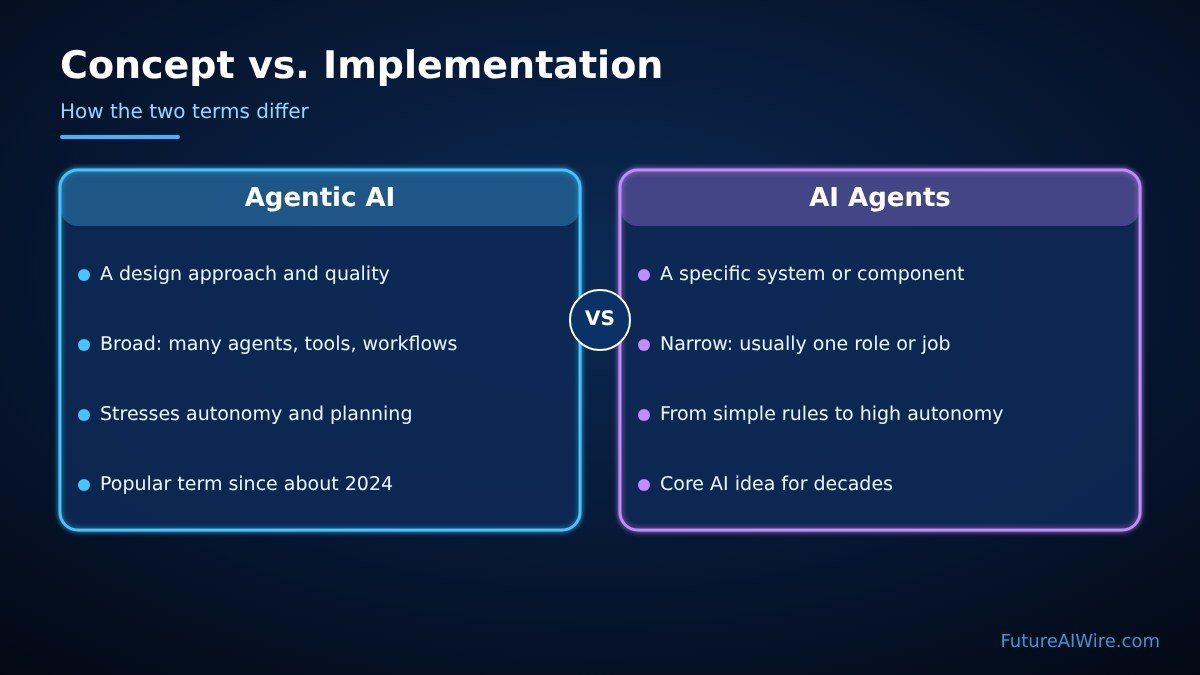
| Aspect | Agentic AI | AI agents |
|---|---|---|
| What it is | A design approach and a quality of AI systems | A specific system or component |
| Scope | Broad: can span many agents, tools and workflows | Narrower: usually one role or job |
| Autonomy | Emphasizes high autonomy and planning | Ranges from simple rules to high autonomy |
| History | Popular term since about 2024 | Core AI concept for decades |
| Example | A system that plans and runs a full marketing campaign | A single agent that drafts and sends emails |
Where the Two Overlap
The confusion is understandable because vendors use both terms for the same products. A modern LLM-based agent that plans, calls tools and checks its own output is both an AI agent and an example of agentic AI. The difference shows up at the edges:
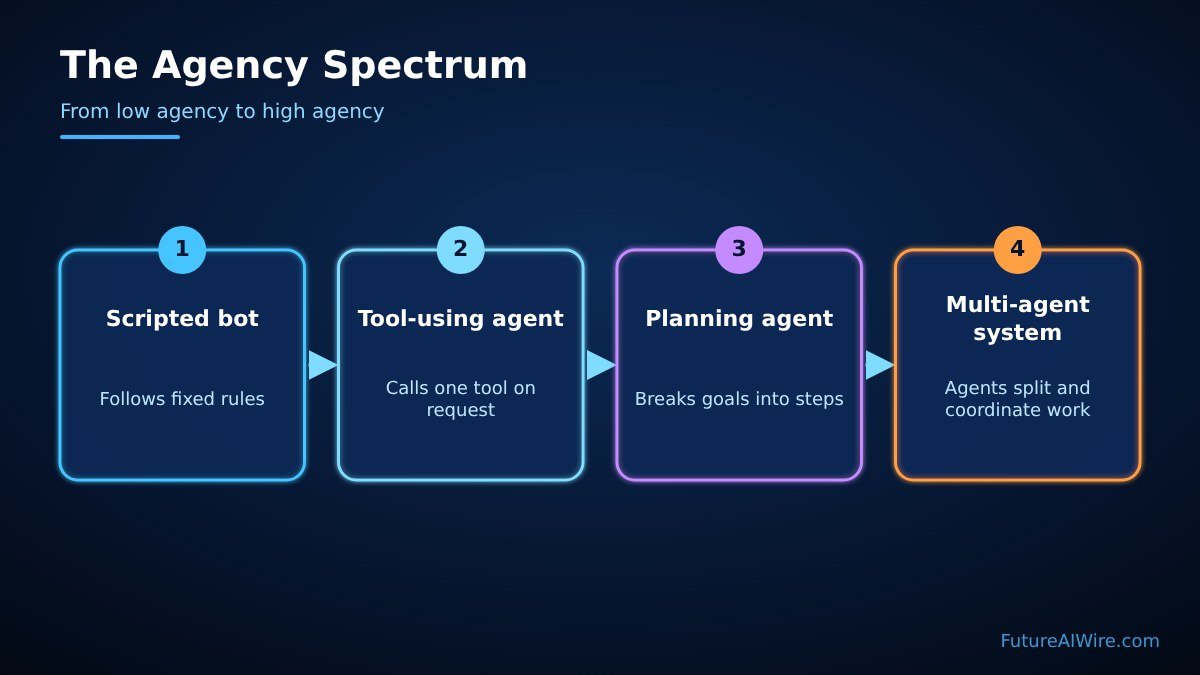
- Low-agency agents: a rule-based chatbot that follows a fixed script is technically an agent but is not very agentic. See the comparison of AI agents and chatbots.
- Multi-agent systems: an agentic AI setup may include a planner agent, a research agent and a reviewer agent working together, as explained in the guide to multi-agent systems.
How Agentic AI Differs From Generative AI
A related question is how agentic AI compares with generative AI. Generative AI creates content, such as text or images, in response to a prompt. Agentic AI uses that ability as one step in a loop of planning and action. A deeper breakdown is in agentic AI vs generative AI.
A Simple Example
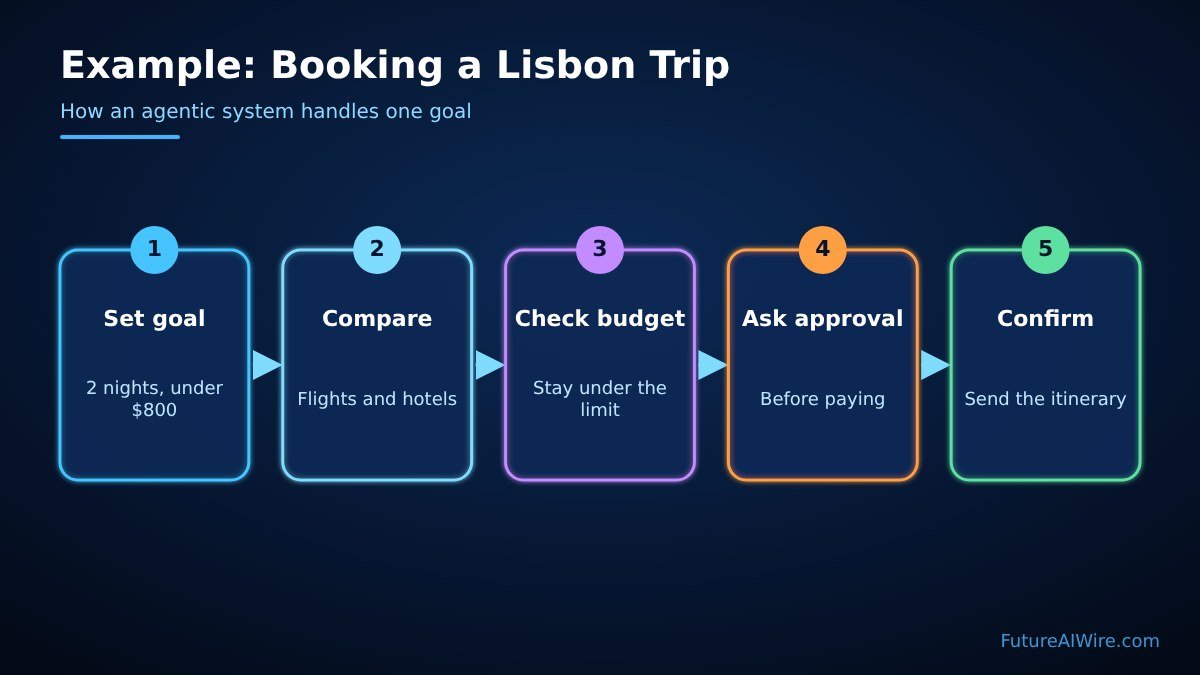
Consider a travel request: “Book a two-night trip to Lisbon under $800 next month.”
- A basic AI agent might search flights and return options for a person to choose.
- An agentic AI system would set sub-goals, compare flights and hotels, check the budget, hold a booking, ask for approval before paying and confirm the itinerary.
Both involve agents. The second shows much more agency.
Which Term Should Teams Use?
Use “AI agent” when talking about a specific tool or component with a clear job. Use “agentic AI” when describing the overall approach, a platform strategy or a system where several agents and tools work toward larger goals. Being precise helps buyers compare products and helps teams set the right level of human oversight, since more agency usually means more need for guardrails such as spending limits and approval steps.
Key Terms at a Glance
- Agency: the ability to pursue a goal by choosing and taking actions.
- Tool use: an AI model calling external functions, APIs or apps.
- Orchestration: coordinating several agents or steps toward one outcome.
- Human in the loop: a person approves key decisions before the system acts.
- Large language model (LLM): the text-based model that often powers an agent’s reasoning.
Conclusion
Agentic AI is the approach and the quality of acting with autonomy, while AI agents are the systems that put it into practice. The terms overlap heavily for modern LLM-based tools, but keeping them separate makes it easier to judge how much autonomy a product really has.
Frequently Asked Questions
Is agentic AI the same as an AI agent?
No. Agentic AI is a broader approach to building autonomous, goal-driven systems. An AI agent is one system that perceives, decides and acts. Many modern agents are agentic, but the terms are not identical.
Can an AI agent exist without being agentic?
Yes. A simple rule-based agent, such as a scripted support bot, acts on inputs but does not plan or adapt, so it shows little agency.
Is ChatGPT an AI agent?
Standard chat is mostly generative. Features that browse, run code or complete tasks on their own act as AI agents within ChatGPT.
Are multi-agent systems examples of agentic AI?
Yes. When several agents split a goal into tasks and coordinate their work, the overall system is a clear form of agentic AI.
Why does the difference matter for businesses?
It helps buyers judge how much autonomy a product has and how much oversight, testing and security it needs before it touches real data or money.

The Future AI Wire Editorial Team covers artificial intelligence, AI agents, agentic AI, and emerging technologies. We publish clear, research-informed explanations and practical insights to help readers understand AI developments, real-world applications, and the technologies shaping the future.