

OpenAI Dots, the always-on personal agents inside ChatGPT, are expensive to run. Adam Fry, who leads ChatGPT’s consumer business, told reporters at an OpenAI dinner in New York on November 2, 2026 that Dots are “on the compute-heavier side,” according to Big Technology and Fortune. The same week, Elon Musk said the cost of running Grok Bot is “unsustainably high relative to revenue.”
This article reflects reporting available as of November 4, 2026.
Key Takeaways
- ChatGPT consumer lead Adam Fry said Dots currently use a lot of compute and that OpenAI wants to “dial back” those needs over time.
- Fortune reported that OpenAI will now route Dots tasks across several models, including a smaller, cheaper one.
- Musk said Grok Bot, the personal assistant launched in August, costs too much to serve relative to the revenue it brings in.
- Both companies are betting on personal agents, but the cost of keeping them running is now a public problem.
Table of Contents
The Short Answer
Personal AI agents such as Dots and Grok Bot do far more work per user than a chatbot. Each one runs tasks in the background, checks accounts and takes actions, which uses large amounts of computing power. Both OpenAI and xAI’s parent have now said publicly that this cost is too high, and both are looking for ways to cut it.
What Adam Fry Said About Dots
Dots launched in late September as a premium, always-on assistant that works across iMessage, email and the ChatGPT app. Access currently requires the $100-per-month Pro plan, according to both reports. Fortune reported that each Dot gets its own cloud computer, which it uses to run tasks and connect to the user’s accounts and services, such as email or ticket booking.
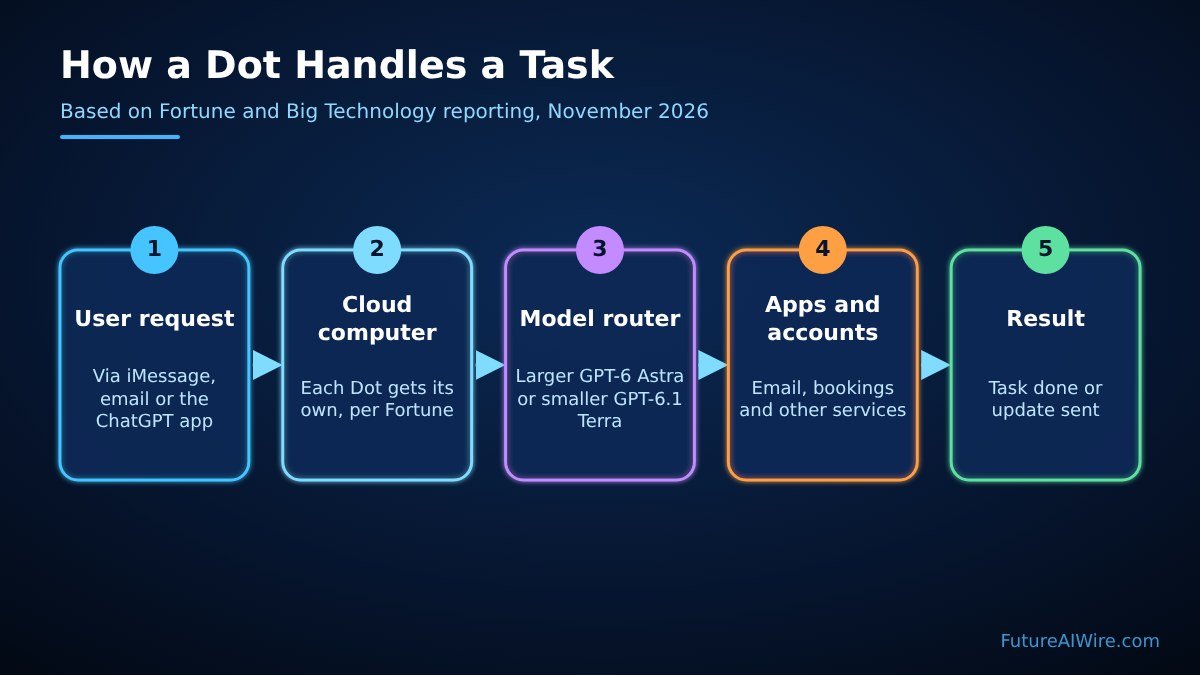
Speaking to Big Technology’s Alex Kantrowitz, Fry said Dots are “on the compute-heavier side” and that OpenAI wants to “dial back” those needs over time. He said OpenAI started with “some of our best models” and plans to build more efficient agentic models. Fry did not give a date for wider access, saying OpenAI had nothing to share about when Dots would reach more users.
Fry also argued that revenue can catch up with costs. He told Big Technology that between credits, subscriptions and ads, he is confident a Dot “is going to be able to pay for itself.”
OpenAI Is Routing Dots Tasks to Smaller Models
Fortune reported that OpenAI will now send Dots tasks to different underlying models rather than running everything on its largest one. That includes GPT-6.1 Terra, a smaller model that uses less compute than GPT-6 Astra, which originally powered all Dots tasks. The goal is to make each task cheaper without hurting quality.
In the Big Technology interview, Fry pointed to OpenAI’s newer models being “much more efficient” than Astra. Neither report gave figures on how much the router will save.
Musk Says Grok Bot Costs Are Too High
Grok Bot is the personal AI assistant SpaceX launched in August, after xAI became part of the company. Fortune reported that Musk said this week its running cost is “unsustainably high relative to revenue.” He suggested cutting the compute each user gets, which would mean users hit usage limits sooner.
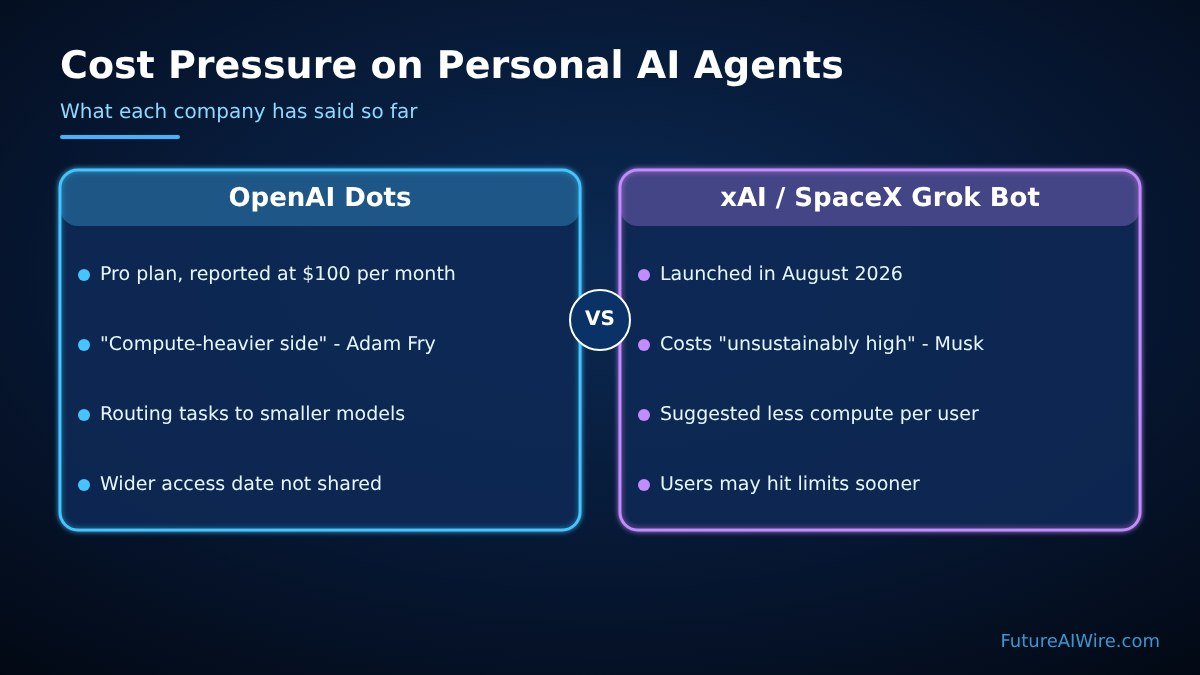
The comment matters because Grok Bot is a direct competitor to Dots and to Meta’s Muse assistant. If the cheapest path is tighter limits, users of paid personal agents may get less for the same price in the near term.
The Bigger Compute Picture
The Dots and Grok Bot comments came during a week of compute-heavy news across the industry:
- OpenAI funding: Fortune, citing the Wall Street Journal, said OpenAI’s latest round raised about $11 billion against a $30 billion target.
- Compute campuses: OpenAI has started calling its data centers “compute campuses” and promised to limit strain on local power grids, according to Fortune.
- Anthropic’s filing: Anthropic’s amended S-1 lists about $895.4 billion in purchase commitments, almost all for compute and infrastructure. FutureAIWire covered the filing in its Anthropic IPO S-1 report.
For background on the funding gap, see FutureAIWire’s earlier report on the OpenAI funding round.
ChatGPT Usage Figures Shared at the Same Dinner
Fry also shared several usage numbers with Big Technology. These are OpenAI’s own figures and have not been independently checked.
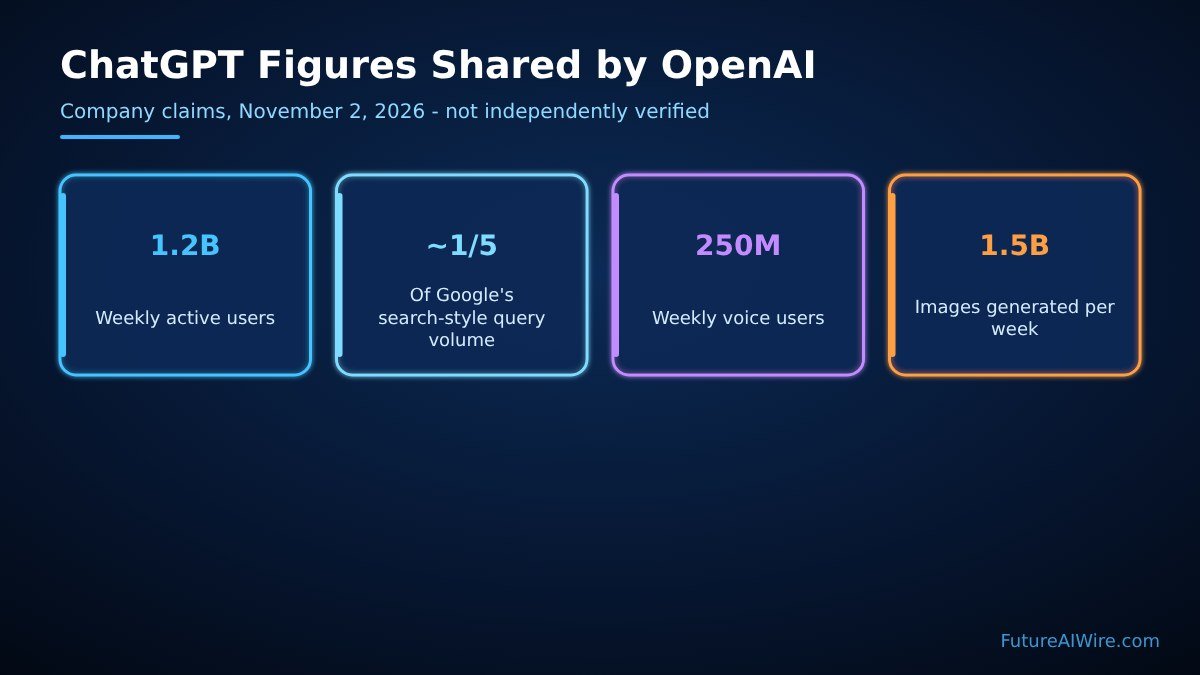
| Metric | Figure given by OpenAI |
|---|---|
| ChatGPT weekly active users | About 1.2 billion |
| Search-style queries vs. Google | Roughly one-fifth of Google’s volume |
| Weekly voice users | 250 million |
| Images generated per week | About 1.5 billion |
Why OpenAI Dots Matter for Personal AI Agents
The industry has spent 2026 moving from chatbots to agents that act for users. Those agents need to stay running, remember context and call tools, which is what makes them expensive. FutureAIWire’s explainer on how AI agents work covers why each step adds cost.
The open questions now are whether cheaper models can keep quality high, whether prices will rise or limits tighten, and when OpenAI will open Dots beyond Pro subscribers. For a wider view of the field, see the AI agents explained guide.
Key Terms at a Glance
- Personal AI agent: an assistant that carries out tasks for one user, such as booking or email triage, often in the background.
- Compute: the processing power, usually GPUs in data centers, needed to run AI models.
- Model routing: sending each task to the model best suited to it, often a smaller one for simple jobs, to save cost.
- Inference cost: the cost of running a trained model each time it answers or acts.
Frequently Asked Questions
What are Dots in ChatGPT?
Dots are always-on personal agents in ChatGPT. They work across iMessage, email and the ChatGPT app and can carry out tasks such as handling email or booking tickets.
How much do Dots cost?
Dots are currently limited to ChatGPT Pro subscribers, a plan reported at $100 per month. OpenAI has not said when cheaper plans will get access.
Why are personal AI agents so expensive to run?
They run tasks continuously, keep context and use tools, and Fortune reported each Dot gets its own cloud computer. That uses far more compute than answering a single chat message.
What did Elon Musk say about Grok Bot?
According to Fortune, Musk said Grok Bot’s running cost is unsustainably high relative to revenue and suggested reducing compute per user, which would mean faster usage limits.
Is OpenAI changing how Dots work?
Fortune reported that OpenAI will route Dots tasks across several models, including the smaller GPT-6.1 Terra, to reduce compute use.
Sources

The Future AI Wire Editorial Team covers artificial intelligence, AI agents, agentic AI, and emerging technologies. We publish clear, research-informed explanations and practical insights to help readers understand AI developments, real-world applications, and the technologies shaping the future.