
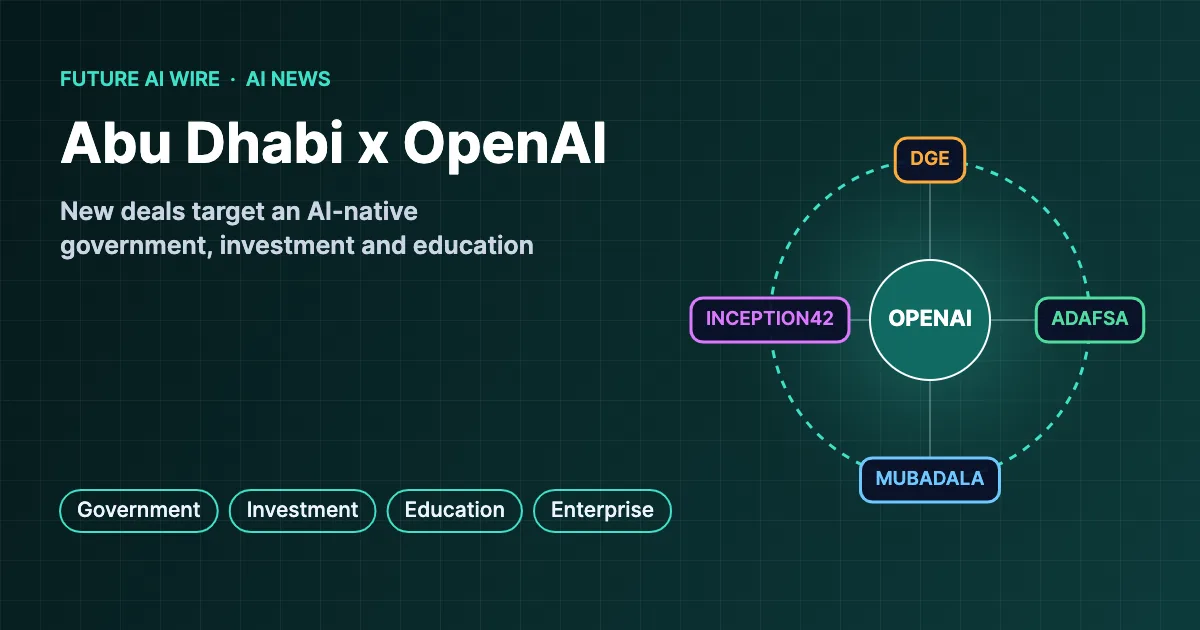
Abu Dhabi has signed a set of artificial intelligence agreements with OpenAI that aim to reshape how the emirate runs government services, analyzes investments, and brings advanced AI into businesses and schools. The OpenAI Abu Dhabi agreements, reported by The National on November 2, 2026, followed a meeting between Sheikh Khaled bin Mohamed, Crown Prince of Abu Dhabi, and OpenAI chief executive Sam Altman. The centerpiece is what the two sides describe as the world’s first AI-native “Machine-Readable Government” initiative.
Key Takeaways
- Abu Dhabi and OpenAI agreed on a series of deals covering government services, investment, the food sector, and education.
- A Machine-Readable Government (MRG) initiative will turn selected regulations into a format AI systems can use for compliance checks.
- The first MRG pilot is already in production with the Abu Dhabi Agriculture and Food Safety Authority, focused on food imports.
- Mubadala, Inception42, and OpenAI will use advanced AI for investment analysis and risk assessment.
- Inception42 and OpenAI signed a five-year agreement to expand frontier AI across UAE government, enterprise, and education.
- No financial terms were disclosed.
Table of Contents
What Was Announced in the OpenAI Abu Dhabi Agreements?
According to The National, the package includes several distinct agreements. Promotional material accompanying the report referred to four strategic agreements, while the article itself detailed three main components. Each targets a different part of the emirate’s economy.
| Agreement | Partners | Purpose |
|---|---|---|
| Machine-Readable Government initiative | Abu Dhabi Government (led by the Department of Government Enablement) and OpenAI | Convert selected policies and regulations into machine-readable form to support AI-assisted compliance checks |
| Investment analysis agreement | Mubadala, Inception42, and OpenAI | Apply advanced AI to investment analysis, opportunity identification, and risk assessment |
| Five-year enterprise agreement | Inception42 and OpenAI | Accelerate adoption of frontier AI across UAE government, enterprise, and education |
Inside the Machine-Readable Government Initiative
The most ambitious part of the announcement is the Machine-Readable Government, or MRG, initiative. Government rules are usually written for people to read and interpret. Under MRG, a defined set of policies and regulations will be translated into a structured format that AI systems can process directly.
The goal is to help officials with routine regulatory compliance checks, including those linked to permits and certificates. According to the report, every assessment produced by the system can be traced back to the specific rule that governs it, and government officials keep oversight and accountability for final decisions. In other words, the AI prepares and checks, while people remain responsible for the outcome.
The initiative is led and governed by the Department of Government Enablement – Abu Dhabi (DGE). Its first pilot is already in production with the Abu Dhabi Agriculture and Food Safety Authority (ADAFSA), where it focuses on food imports. Food import checks involve many overlapping requirements, such as documentation, origin, labeling, and safety standards, which makes them a practical testing ground for rule-based AI assistance.
Why Food Imports Make Sense as a First Test
Choosing food imports for the first pilot reflects several practical advantages. The UAE imports a large share of its food, so the volume of applications is high and any time savings add up quickly. The checks are also largely rule-based: shipments must match documentation, meet labeling and safety standards, and come from approved sources. That structure makes it easier to translate requirements into machine-readable conditions and to measure whether the system gets them right.
Food safety is also an area where traceability matters greatly. If a shipment is approved or rejected, both regulators and importers need to understand exactly why. A system that links every finding to a specific rule supports that need. Lessons from this pilot, such as how well documents are read, how exceptions are handled, and how officials interact with AI recommendations, are likely to shape how MRG expands to other departments.
Where the Data Is Processed
Data location is a central concern for any government using AI. The report states that processing for MRG runs on OpenAI’s UAE inference residency, meaning real-time model computation takes place on GPUs located in data centers inside the UAE. Keeping computation in the country is designed to address data sovereignty and security requirements that many governments apply to sensitive information.
AI for Investment Decisions at Mubadala
The second agreement brings together Mubadala, one of Abu Dhabi’s major sovereign investors, with Inception42 and OpenAI. The partners plan to deploy advanced AI to support investment analysis, identify opportunities, and assess risk, with the stated aim of enabling more informed investment decisions.
Sovereign and institutional investors process enormous volumes of financial filings, market data, research, and news. Language models can summarize documents, compare companies, and surface patterns quickly, although human analysts still need to validate conclusions. The report did not specify which investment teams will use the tools or how results will be measured.
A Five-Year Pact to Spread Frontier AI
The third agreement is a five-year deal between Inception42 and OpenAI to enable adoption of frontier AI across government, enterprise, and education in the UAE. Under the arrangement, the companies will jointly deliver enterprise solutions that pair OpenAI’s frontier models and engineering expertise with Inception42’s applied AI and consultancy-led professional services.
This model is increasingly common in large AI rollouts. Model developers supply the core technology, while local partners handle integration, customization, training, and ongoing support, which is often the hardest part of turning AI pilots into everyday tools.
What the Leaders Said
Altman praised the UAE for setting what he called a “bold, global standard” for integrating AI across the public and private sectors. The report also described the initiative as a step toward making Abu Dhabi the world’s first AI-native government, an ambition that has featured prominently in the emirate’s digital plans.
What Has Not Been Disclosed
Several important details remain unknown based on the published report:
- Financial terms: no deal values or investment amounts were announced.
- Timelines: beyond the ADAFSA pilot already running, there is no public schedule for expanding MRG to other agencies.
- Results: no performance metrics from the food import pilot were shared.
- Scope: the number of regulations, agencies, or users involved has not been specified.
Why This Matters
A Template for AI in Government
Many governments are experimenting with chatbots for citizen questions. Turning regulations themselves into machine-readable form goes further, because it lets AI systems check applications against rules in a consistent, traceable way. If the approach works, it could speed up permits and approvals while making decisions easier to audit. If it fails, it could also highlight how hard it is to encode legal nuance and exceptions.
Accountability Built In
The emphasis on traceability and human oversight reflects a wider trend in responsible AI. Systems that can show exactly which rule led to a recommendation are easier to challenge and correct than black-box decisions. This matters because language models can still produce errors, and in government, a wrong answer can affect businesses and citizens directly.
The Gulf’s AI Ambitions
The UAE has positioned itself as an early adopter of AI for years. It appointed a minister of state for artificial intelligence in 2017 and has invested heavily in data centers, research, and partnerships with global technology companies. Abu Dhabi-based G42 and its affiliated companies have become central to many of these efforts, and the emirate has hosted a series of high-profile agreements with US AI developers. The new deals add a government-operations layer to that infrastructure push.
Competition Among AI Providers
For OpenAI, large public-sector and sovereign partnerships offer revenue, real-world deployment experience, and influence over how AI is governed. The company has pursued similar country-level partnerships as part of a broader strategy, and rivals including Microsoft, Google, Anthropic, and others are competing for government contracts worldwide. Readers following OpenAI’s business strategy can find related coverage in OpenAI’s latest funding round and its decision to train frontier models offline.
How Machine-Readable Rules Work With AI Agents
Machine-readable regulation fits naturally with the rise of AI agents, which can take multi-step actions such as gathering documents, checking requirements, and preparing decisions. An agent working with structured rules can test an application against each requirement and explain which ones are met or missing. These concepts are covered in more depth in AI agents explained and what agentic AI is. Clear rules also reduce the room for a model to guess, which is one of the main causes of AI errors.
How AI-Assisted Compliance Checks Typically Work
While Abu Dhabi has not published technical details of MRG, AI-assisted compliance systems generally follow a similar sequence:
- Encode the rules. Legal and policy experts translate requirements into structured conditions, such as required documents, thresholds, and exceptions.
- Collect the application. The system receives forms, certificates, invoices, and supporting files from the applicant.
- Extract the facts. AI reads the documents and pulls out relevant details, such as product types, origins, dates, and certificate numbers.
- Check each requirement. The extracted facts are compared with each encoded rule.
- Explain the result. The system produces an assessment that cites the exact rule behind each finding.
- Human decision. An official reviews the assessment, resolves edge cases, and makes the final call.
The traceability step is what separates this approach from simply asking a chatbot whether something is allowed. By linking every finding to a specific rule, the system creates an audit trail that officials, applicants, and regulators can inspect.
How Other Governments Are Using AI
Abu Dhabi is not alone in experimenting with AI in public administration, although approaches differ widely.
| Approach | What it involves | Typical goal |
|---|---|---|
| Citizen-facing assistants | Chatbots that answer questions about services, forms, and eligibility | Faster answers and fewer calls to service centers |
| Internal productivity tools | AI assistants that help civil servants draft documents, summarize consultations, and search policies | Saving staff time on routine writing and research |
| Document processing | Automated extraction of data from applications and records | Shorter processing times for permits and benefits |
| Rules as code | Expressing legislation in machine-readable form | Consistent, testable, and transparent application of rules |
Countries such as Estonia and Singapore have long been cited as leaders in digital government, and several national governments have launched internal AI assistants for civil servants in recent years. The broader idea of “rules as code,” where legislation is written or translated into machine-readable form, has been explored by public-sector innovators and researchers for more than a decade. What sets the Abu Dhabi effort apart is its explicit pairing of machine-readable regulation with a frontier AI provider and in-country computing at government scale.
Potential Benefits and Risks at a Glance
| Potential benefits | Potential risks |
|---|---|
| Faster processing of permits and certificates | Errors if rules are encoded incorrectly or documents are misread |
| More consistent application of regulations | Reduced flexibility for unusual cases |
| Clear audit trails linking decisions to rules | Over-reliance on automated recommendations by busy officials |
| Freed-up staff time for complex cases | Long-term dependence on external technology providers |
| Easier updates when regulations change | Privacy and security concerns around sensitive data |
Questions Critics Are Likely to Raise
- Transparency: how will the public know which decisions involved AI, and can applicants see the reasoning?
- Error handling: what happens when the system misreads a rule or an application?
- Vendor dependence: how dependent will government operations become on a single foreign AI provider over a five-year period?
- Data protection: while in-country processing addresses residency, questions about access, retention, and auditing remain.
- Resource use: expanding AI infrastructure raises energy and water demands, an issue explored in how much water AI uses.
What It Could Mean for Businesses and Residents
For companies that import food or apply for permits in Abu Dhabi, the most visible change could be faster and more predictable reviews. When rules are encoded consistently, applicants may receive clearer explanations of missing documents or unmet requirements, rather than vague rejections. Over time, businesses could also gain tools to check their own applications against the same machine-readable rules before submitting, reducing back-and-forth with authorities.
For residents, the impact is likely to be indirect at first, appearing as shorter waiting times and simpler service processes. Education is another area to watch, since the five-year enterprise agreement explicitly includes schools and universities. That could mean AI tutoring, administrative tools for teachers, or AI literacy programs, although no specific education projects were detailed in the report.
Local technology firms and consultancies may also benefit. Large AI rollouts typically require integration work, data preparation, training, and support, creating demand for skilled professionals in the region. At the same time, organizations will need clear internal policies on how staff use AI tools, how outputs are checked, and how sensitive information is protected.
What to Watch Next
The key indicators will be whether the ADAFSA pilot produces measurable gains in speed and accuracy, which agencies join MRG next, and whether Abu Dhabi publishes standards or tools that other governments could adopt. Further details on the Mubadala and Inception42 programs, including use cases and outcomes, would also show how quickly these agreements move from announcement to impact.
Key Terms at a Glance
- Machine-Readable Government (MRG): an approach that converts policies and regulations into structured data that AI systems can process.
- AI-native government: a public sector designed around AI tools from the start rather than adding them later.
- Inference residency: running AI model computation within a specific country’s borders.
- Frontier AI: the most advanced general-purpose AI models available.
- Sovereign investor: a state-owned investment entity that manages national wealth.
Frequently Asked Questions
What is Abu Dhabi’s Machine-Readable Government initiative?
It is a program that translates selected government policies and regulations into a format AI systems can use, helping officials run routine compliance checks for permits and certificates while keeping humans responsible for final decisions.
Which agency is piloting it first?
The Abu Dhabi Agriculture and Food Safety Authority, with a pilot focused on food imports that is already in production.
How much are the deals worth?
The financial terms were not disclosed in the published report.
Where will the AI processing take place?
Processing for the government initiative runs on GPUs in UAE data centers through OpenAI’s in-country inference setup.
Who is Mubadala?
Mubadala is one of Abu Dhabi’s major sovereign investment companies, managing a large global portfolio on behalf of the emirate.
Will AI make final government decisions in Abu Dhabi?
According to the report, no. Officials keep oversight and accountability for final decisions, while AI supports the routine checking process.
Is this related to other UAE AI projects?
It builds on the UAE’s long-running national AI push, which includes major data center investments and partnerships with international technology companies, but the agreements themselves focus on government operations, investment analysis, and enterprise adoption.

The Future AI Wire Editorial Team covers artificial intelligence, AI agents, agentic AI, and emerging technologies. We publish clear, research-informed explanations and practical insights to help readers understand AI developments, real-world applications, and the technologies shaping the future.