
Artificial intelligence is moving beyond answering questions and generating content. In 2026, AI agents are helping people automate workflows, conduct research, write software, and complete tasks that previously required several separate tools.
But what exactly makes an AI agent different from a chatbot? How does it make decisions, remember information, and interact with other applications?
This guide explains how AI agents work, the technology behind them, their practical applications, and the limitations businesses should understand before using them. At Future AI Wire, we explore developments like these to help readers understand the changing world of artificial intelligence.
What Are AI Agents?
AI agents are software systems designed to pursue specific goals by interpreting information, making decisions, and taking actions within a defined environment. Modern agents often combine large language models with external tools, memory systems, and planning capabilities.
Unlike a basic chatbot that primarily generates responses, an AI agent can take multiple steps toward completing a task. Depending on its configuration, it may search for information, analyze documents, execute code, or interact with connected applications.
For example, imagine asking an AI system to research competing products and prepare a market analysis.
A conventional chatbot might suggest a research strategy or generate a report based on information already available to it. An appropriately configured AI agent could search relevant sources, collect product information, organize findings, and prepare a draft report for human review.
The important distinction is not that agents operate without restrictions. Their autonomy depends on the tools, permissions, instructions, and safeguards provided by their developers.
AI Agent vs AI Chatbot: What’s the Difference?
AI agents and AI chatbots share underlying technologies, but their functionality can differ considerably.
AI Chatbots
Traditional AI chatbots focus on conversational interactions. They receive questions or instructions and generate relevant responses.
Modern chatbots can also support web browsing, file analysis, coding tools, and other capabilities. Therefore, the difference between a chatbot and an agent is not always absolute.
AI Agents
AI agents are designed around accomplishing objectives rather than simply producing individual responses.
They can coordinate several actions, evaluate intermediate results, and decide what to do next within their authorized boundaries.
For example, an agent assisting a customer support team might retrieve order information, check company policies, prepare a response, and recommend the next action.
However, sensitive operations such as issuing refunds or modifying customer records should generally require appropriate permissions and safeguards.
How Do AI Agents Work?
Understanding how AI agents work becomes easier when we examine the process behind their decisions.
Although implementations differ, many modern systems follow a recurring cycle of interpreting goals, selecting actions, observing results, and adjusting their approach.
1. Understanding the Goal
The process begins when a user or another system provides an objective.
For example, a user might request a summary of recent developments in renewable energy technology.
The agent identifies the requested outcome and any relevant constraints, such as preferred sources, time periods, or report formats.
2. Planning the Task
Depending on its architecture, the agent may break the objective into smaller activities.
These could include finding research publications, reviewing important developments, comparing findings, and organizing the final report.
3. Using External Tools
Tool access allows agents to interact with information and systems beyond their underlying language model.
Depending on the implementation, available tools may include web search, database queries, code execution, document retrieval, or business software integrations.
4. Observing Results
After an action is performed, the agent receives information about its outcome.
For example, a search tool might return relevant documents, while a code execution tool could return test results or an error message.
5. Adjusting the Approach
The agent can use those observations to decide whether to continue, revise its plan, request clarification, or stop.
One influential approach is the ReAct framework, introduced by researchers who explored combining reasoning and actions in language models.
ReAct is an important research approach, although not every modern AI agent uses this particular framework.
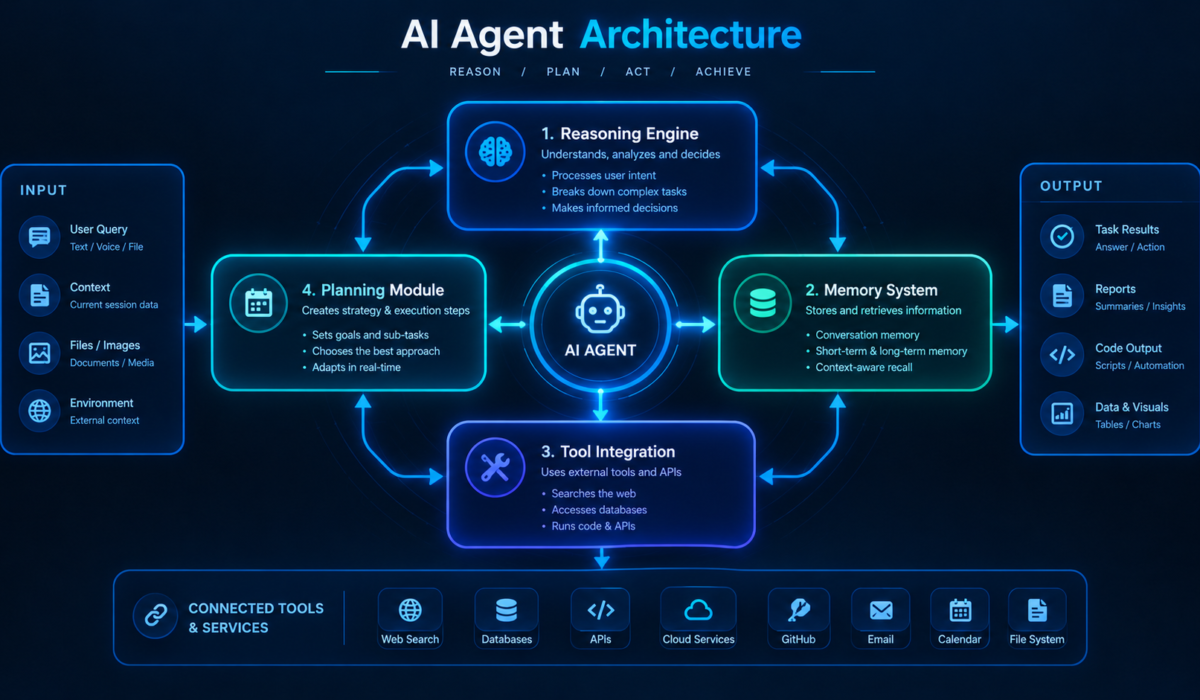
AI Agent Architecture Explained
AI agent architecture refers to the components that allow an agent to process information, make decisions, and perform actions.
Architectures vary depending on the task, but modern language-model-based agents commonly involve several important elements.
Reasoning and Decision-Making
A language model or another decision-making component interprets instructions and determines possible next steps.
The quality of this component influences how well the agent handles uncertainty, complex requests, and unexpected situations.
Planning System
Planning mechanisms help organize activities and determine the order in which tasks should be completed.
Some agents create an initial plan, while others decide their next action dynamically based on new observations.
Memory and Context
Memory mechanisms help preserve information that may be useful during a task.
These can include the current conversation, previous tool results, stored documents, and information retrieved from databases.
Not every agent has persistent memory, and retaining information does not automatically mean the system learns from experience.
Tool Integration
Tools connect the agent to external applications and services.
For example, an agent might use a calendar integration to check availability or a database tool to retrieve authorized records.
Execution Controls
Reliable agent systems also need controls that limit what actions can be performed.
These may include access permissions, approval requirements, spending limits, logging, and restrictions on sensitive operations.
Such controls are particularly important when agents interact with financial systems, private information, or production environments.
AI Agent Memory and Planning
Memory and planning influence how effectively an AI agent manages tasks involving multiple steps.
Short-Term Context
Short-term context contains information relevant to the current interaction or task.
For example, an agent analyzing several documents needs to retain the user’s instructions and relevant findings while preparing its response.
Long-Term Memory
Some agent systems use databases or retrieval mechanisms to access information saved from earlier interactions.
This can help an agent retrieve preferences, previous decisions, or project details.
However, persistent memory introduces privacy and data-management considerations. Organizations should control what information is stored and who can access it.
Planning Complex Workflows
Planning allows agents to organize tasks into smaller activities and track progress toward an objective.
For example, a software development agent might inspect a codebase, identify a bug, propose a change, execute tests, and review the results.
Effective planning does not guarantee success. Errors can accumulate across steps, making verification essential.
Types of AI Agents
AI agents can be classified according to how they make decisions and interact with their environments.
Simple Reflex Agents
Simple reflex agents respond to current conditions using predefined rules.
They are useful in predictable environments but have limited flexibility when situations change.
Goal-Based Agents
Goal-based agents evaluate possible actions according to whether those actions help achieve a defined objective.
This approach is relevant to modern systems designed to complete multi-step tasks.
Utility-Based Agents
Utility-based agents select actions according to an evaluation of expected outcomes.
They can be useful when several possible solutions exist and the system must balance different priorities.
Learning Agents
Learning agents can improve aspects of their behavior using feedback or experience.
It is important to distinguish genuine learning mechanisms from agents that simply retrieve information from stored memory.
Embodied AI Agents
Embodied agents interact with physical environments through sensors, robots, or other hardware.
Examples include robotic systems that perceive objects, navigate environments, and perform physical tasks.
Multi-Agent Systems
Multi-agent systems involve multiple agents working within a shared environment or coordinated workflow.
Different agents may specialize in research, analysis, programming, or reviewing results.
However, using multiple agents does not automatically improve performance. Coordination overhead and communication errors can make some workflows less efficient.
Real-World AI Agent Examples in 2026
By 2026, agent-based capabilities are increasingly visible in software development, business applications, and research tools.
Software Development Agents
Coding agents can inspect repositories, suggest modifications, execute tests, and assist developers with debugging.
Some systems can work through several development steps before presenting changes for review.
Human verification remains important because generated code may contain security vulnerabilities or functional errors.
Customer Support Agents
Customer service systems can retrieve relevant information, classify requests, and assist with routine support workflows.
When connected to approved business tools, they may also help perform limited account-related actions.
Research Assistants
Research-oriented agents can search available information sources, examine documents, organize findings, and prepare summaries.
Their usefulness depends heavily on source quality and the accuracy of retrieved information.
Business Workflow Agents
Organizations can configure agents to assist with recurring activities such as document processing, reporting, and information retrieval.
These applications are most effective when responsibilities, permissions, and verification requirements are clearly defined.
AI Agent Use Cases Across Industries
The potential applications of AI agents extend beyond technology companies.
Healthcare
AI agents may assist healthcare professionals with administrative documentation, literature searches, and research organization.
Clinical applications require rigorous validation, privacy safeguards, and appropriate professional oversight.
Finance
Financial organizations can explore agents for document analysis, compliance support, and information monitoring.
Decisions involving investments, transactions, or sensitive financial records require stronger controls than routine information-processing tasks.
Education
Educational applications may help teachers organize materials, develop practice activities, and provide students with guided learning support.
Accuracy, age-appropriate safeguards, and protection of student information remain important considerations.
Marketing and Research
Marketing teams can use agent-based workflows to organize research, analyze campaign information, and prepare content drafts.
Human editorial review remains essential for factual accuracy, originality, and brand consistency.
Open Source AI Agents
Open-source frameworks make it possible for developers to build and customize agent-based applications.
Projects such as LangGraph, CrewAI, and AutoGen provide different approaches to organizing agent workflows, coordinating components, and connecting external tools.
These frameworks are useful for experimentation and application development, but their capabilities and design philosophies differ.
Organizations considering open-source frameworks should evaluate documentation, maintenance activity, security practices, deployment requirements, and compatibility with existing infrastructure.
Open-source availability also does not automatically guarantee complete privacy. Data protection depends on the models, hosting environment, integrations, and configuration choices used.
Benefits of AI Agents
AI agents can provide meaningful benefits when applied to appropriate tasks.
Workflow Automation
Agents can coordinate multiple activities that would otherwise require repeated manual interaction.
Improved Productivity
By assisting with repetitive research, analysis, and administrative work, agents may reduce the time people spend on certain workflows.
Flexible Task Execution
Unlike rigid automation scripts, some agents can adjust their actions when intermediate results differ from expectations.
Better Integration Between Tools
Agents can help connect information and activities across applications through authorized integrations.
However, these benefits depend on implementation quality. Complex agent systems can sometimes be slower, more expensive, or less reliable than simpler automation.
Limitations and Challenges of AI Agents
Despite their capabilities, AI agents face several important limitations.
Accuracy and Reliability
Agents can generate incorrect information, misunderstand instructions, or make poor decisions.
Errors occurring early in a workflow may affect later actions.
Security Risks
Agents that read external content can encounter malicious instructions, including prompt injection attempts.
Tool permissions should therefore be restricted, and sensitive actions should be protected by appropriate safeguards.
Operational Costs
Multi-step agent workflows may require repeated model calls, tool usage, and external services.
Costs can become significant when tasks involve extensive processing or repeated attempts.
Limited Autonomy
Agents do not possess unlimited independent capabilities.
Their effectiveness depends on available tools, environmental access, system design, and the quality of their instructions.
Human Oversight
Human supervision remains particularly important for decisions involving safety, finances, confidential information, or irreversible actions.
Organizations should establish clear approval processes and evaluate agent performance before expanding autonomy.
Future of AI Agents: 2026–2030
The future of AI agents will depend on improvements in reliability, planning, model capabilities, security, and integration with existing software.
Through the remainder of 2026 and beyond, developers are likely to focus on making agent workflows more predictable and easier to evaluate.
Better monitoring systems and stronger permission controls could help businesses introduce agents into more demanding environments.
Between 2027 and 2030, more sophisticated multi-agent applications and embodied systems may become commercially practical.
However, the speed and extent of adoption remain uncertain. Technical limitations, costs, regulations, and organizational requirements will influence how widely these systems are deployed.
Readers interested in the broader technology behind autonomous, goal-directed systems can explore our guide to agentic AI.
Conclusion
AI agents are changing how software systems interact with information, applications, and digital workflows.
Their defining capability is not simply generating answers but coordinating actions toward specific objectives.
Understanding their architecture, memory mechanisms, planning capabilities, and limitations provides a useful foundation for evaluating this technology.
As agent-based systems continue developing, their practical value will depend less on promises of complete autonomy and more on reliability, appropriate safeguards, and measurable results.
Frequently Asked Questions
What are AI agents in simple terms?
AI agents are software systems that can pursue specific objectives by processing information, selecting actions, and using available tools. Some agents can complete multi-step tasks with limited human involvement.
How are AI agents different from chatbots?
Traditional chatbots mainly respond to individual requests. AI agents are designed to coordinate actions toward goals. However, modern chatbot products can also include agent-like capabilities.
Do AI agents need human supervision?
Yes, particularly for sensitive or high-impact tasks. The appropriate level of oversight depends on the reliability of the system and the consequences of potential errors.
Can AI agents remember previous conversations?
Some agents can retrieve information from previous interactions using persistent storage or memory systems. This capability depends on how the application is designed and configured.
Are AI agents the same as artificial general intelligence?
No. AI agents are systems designed to perform actions toward objectives. Artificial general intelligence refers to a broader concept of AI capable of performing a wide range of intellectual tasks at a general level.
Will AI agents replace human jobs by 2030?
AI agents may automate portions of existing jobs and change how certain tasks are performed. Their overall employment impact remains uncertain and will depend on technological progress, adoption, and economic factors.

1 Comment